JioPlus is Jio’s postpaid mobile service, and a JioPlus family plan lets one main connection link a few add-on numbers so the household pays a single monthly bill. The person who holds the main connection receives the bill, while every member keeps their own SIM, number and identity verification.
If you are tired of tracking several prepaid recharges with different expiry dates, this setup can make life simpler. This guide explains how the family plan is structured, what members usually get, who it suits and what to check before you sign up.
- JioPlus is the name for Jio’s postpaid plans, with options for individuals and families.
- A family plan has one primary connection and a small number of add-on members.
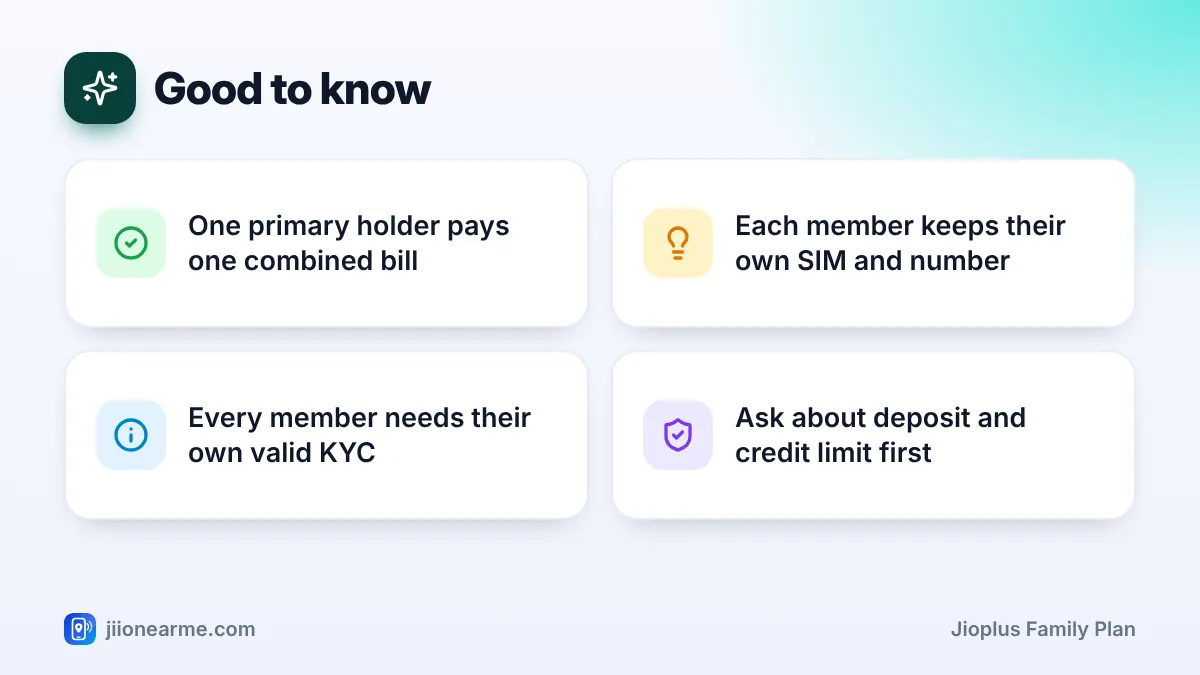
- The primary holder receives and pays one combined bill for everyone.
- Each member has their own SIM, number and KYC.
- Benefits, member limits and deposits change, so check current details in MyJio or on jio.com.
What JioPlus Means in Simple Terms
JioPlus is the label Jio uses for its postpaid mobile plans. With postpaid, you use services first and pay later through a monthly bill. With prepaid, you pay first by recharging and then use the benefits until the plan expires.
JioPlus includes plans for a single user and family plans for households. The family plans are the main reason many people look at JioPlus. They let a parent, spouse, child or other relative join one account instead of managing separate recharges.
Nothing about daily phone use changes. You still make calls, send SMS and use mobile data as usual. The main difference is how and when you pay.
How a JioPlus Family Plan Works
A JioPlus family plan is built around one main account with linked members. Think of it like a household electricity connection with one bill, except that every person still has a separate phone number.
The primary connection
The primary connection belongs to the person who takes the plan. This person is the account holder. The monthly bill is generated in their name, and they are responsible for paying it on time. The primary holder can usually see bill details and manage the account through the MyJio app.
Add-on members
Add-on members are the extra connections linked to the primary account. A family plan allows a limited number of add-ons, often up to three, though this depends on the plan you choose. Each add-on member gets their own SIM and keeps their own number. A member can usually join with a new number, an existing Jio number, or a number ported from another operator, subject to Jio’s process.
One combined bill
Instead of separate payments, the charges for the primary connection and all add-ons appear on one bill. The primary holder pays this single bill, often through autopay, UPI or another payment method in the MyJio app or on jio.com.
Even though the bill is shared, every add-on member completes their own KYC with a valid ID. A SIM should always be registered to the person who will actually use it.
What Members Usually Get on a JioPlus Family Plan
The exact benefits change from time to time, so treat this as a general picture rather than a fixed list. Most JioPlus family plans include:
- Calling and SMS for the primary and add-on members, as per the plan terms.
- Mobile data for the family, either as a shared allowance, a set amount per member, or a mix of both, depending on the plan.
- Jio True 5G access where the plan, the phone and the area support it.
- App benefits on some plans, such as access to selected Jio apps or streaming services.
Because data and app benefits vary, read the plan details carefully before you pick one. The MyJio app and the official Jio website show the current list for every plan.
Before choosing, check how much data each family member used over the last few months. The usage history in each person’s MyJio app is a good starting point.
Who a JioPlus Family Plan Suits
A family plan works best when one person is happy to manage the account and pay for everyone. It is less useful if each person wants full financial independence.
| Household situation | Is a family plan a good fit? |
|---|---|
| Parents managing phones for children or elderly relatives | Usually yes, as one person controls payment |
| Couples who share household expenses | Often yes, as one bill is simpler to track |
| Adult siblings who prefer to pay separately | Often no, as separate connections may suit better |
| Members with very different data needs | Depends on how the plan shares data |
| Someone who wants to avoid any deposit | Prepaid may be easier |
A family plan also helps when someone in the house often forgets to recharge. On postpaid, service continues through the billing cycle as long as bills are paid on time and usage stays within the credit limit.
How to Get Started With JioPlus
You should sign up for a JioPlus family plan only through official Jio channels. The general flow looks like this:
- Compare the current family plans in the MyJio app or on jio.com.
- Decide who will be the primary holder. This person receives the bill and pays it.
- Request the plan through the MyJio app, the Jio website or a Jio Store. Existing Jio prepaid users may see an option to switch to postpaid inside the app.
- Complete KYC for the primary holder with a valid ID, as per the official process.
- Add family members one by one. Each member completes their own KYC and either receives a new SIM or converts their existing number.
- Check the activation messages and confirm every number works for calls and data.

Menus in the MyJio app change from time to time, so the exact labels may differ slightly on your version.
Things to Check Before You Sign Up
A little homework before you switch prevents surprises on the first bill.
- Security deposit: Postpaid connections may need a refundable security deposit, depending on the plan and your eligibility. Ask about it before you confirm.
- Credit limit: Every postpaid account has a credit limit. If usage charges cross it, some services may be restricted until you pay.
- Network coverage: Make sure Jio coverage is good at home and at each member’s workplace, college or school.
- Phone compatibility: Members need a 4G VoLTE or 5G phone for calls and data on Jio.
- Extra charges: Usage beyond plan limits, international roaming and premium services can add to the bill.
Only sign up through the MyJio app, jio.com or a Jio Store. Never share an OTP, Aadhaar details or passwords with anyone who calls or messages you claiming to set up a family plan for you.
Frequently Asked Questions
Is JioPlus the same as Jio Postpaid?
Yes, JioPlus is the name Jio uses for its postpaid mobile plans. It covers both individual plans and family plans.
How many members can join a JioPlus family plan?
Most family plans allow a small number of add-on members, often up to three. The exact limit depends on the plan, so check the plan details in MyJio or on jio.com.
Do add-on members get a separate number?
Yes. Every add-on member has their own SIM and number. Only the account and the bill are shared with the primary holder.
Can a member keep their existing number?
Usually yes. An existing Jio prepaid number can often be converted, and a number from another operator can be ported in through mobile number portability.
Who pays the JioPlus family bill?
The primary account holder receives the combined bill and is responsible for paying it. Family members can help with money, but the account stays in the primary holder’s name.
Final Thoughts
A JioPlus family plan is simply one postpaid account with a few linked numbers and one monthly bill. It suits households where one person is comfortable managing payments for everyone.
Before you switch, compare the current plans, note your family’s real data use, and ask about deposits and credit limits. Use only official channels, and call 199 from a Jio number if you have questions about your account.
JIo Near me is an independent guide and is not affiliated with Reliance Jio. App menus, plans and policies can change – always confirm current details in the official MyJio app or on jio.com. We will never ask for your OTP, PIN or passwords.