Call 1930 as soon as you realise money has left your account through online fraud. The national cybercrime helpline 1930 is meant for financial cyber fraud, such as UPI, card, net banking and wallet scams. Reporting quickly gives banks and police the best chance to hold the money before fraudsters move it further.
This guide explains why speed matters, what to do in the first hour, how to file a complaint on cybercrime.gov.in and which transaction details to note down.
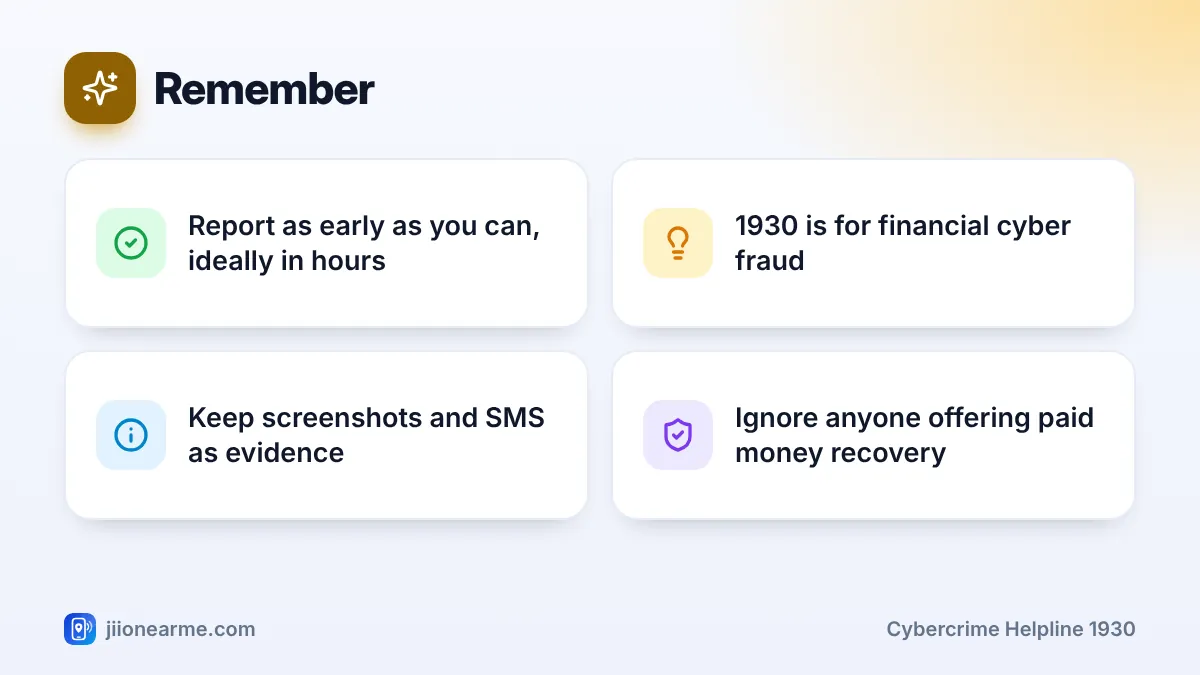
- Call 1930 immediately after any financial cyber fraud. Speed improves the chance of stopping the money.
- Also call your bank’s official helpline to block cards, UPI or net banking.
- File or complete your complaint on cybercrime.gov.in and save the acknowledgement number.
- Note the UTR or transaction ID, date, time, amount and the receiver’s account or UPI ID.
- Ignore anyone who offers to “recover” your money for a fee.
Why Calling the Cybercrime Helpline 1930 Quickly Matters
When fraudsters receive money, they usually move it quickly through several accounts, often called mule accounts, and then withdraw it. Each step makes recovery harder.
The 1930 helpline is linked to a reporting system that connects police with banks and payment companies. When you report, the transaction details can be passed to the banks involved, so they can try to put a hold on the money if it is still in an account. The earlier you call, the more likely this is to work. That is why advisories often talk about reporting in the “golden hour” after a fraud.
Quick reporting also matters with your own bank. RBI rules limit a customer’s liability for unauthorised electronic transactions that are reported promptly, though each case is judged on its own facts.
Many victims lose time calling the fraudster back, arguing with them or searching online for a customer care number, which can lead to a fake one. Call 1930 and your bank first, then do everything else.
What to Do in the First Hour
Follow these steps in order.
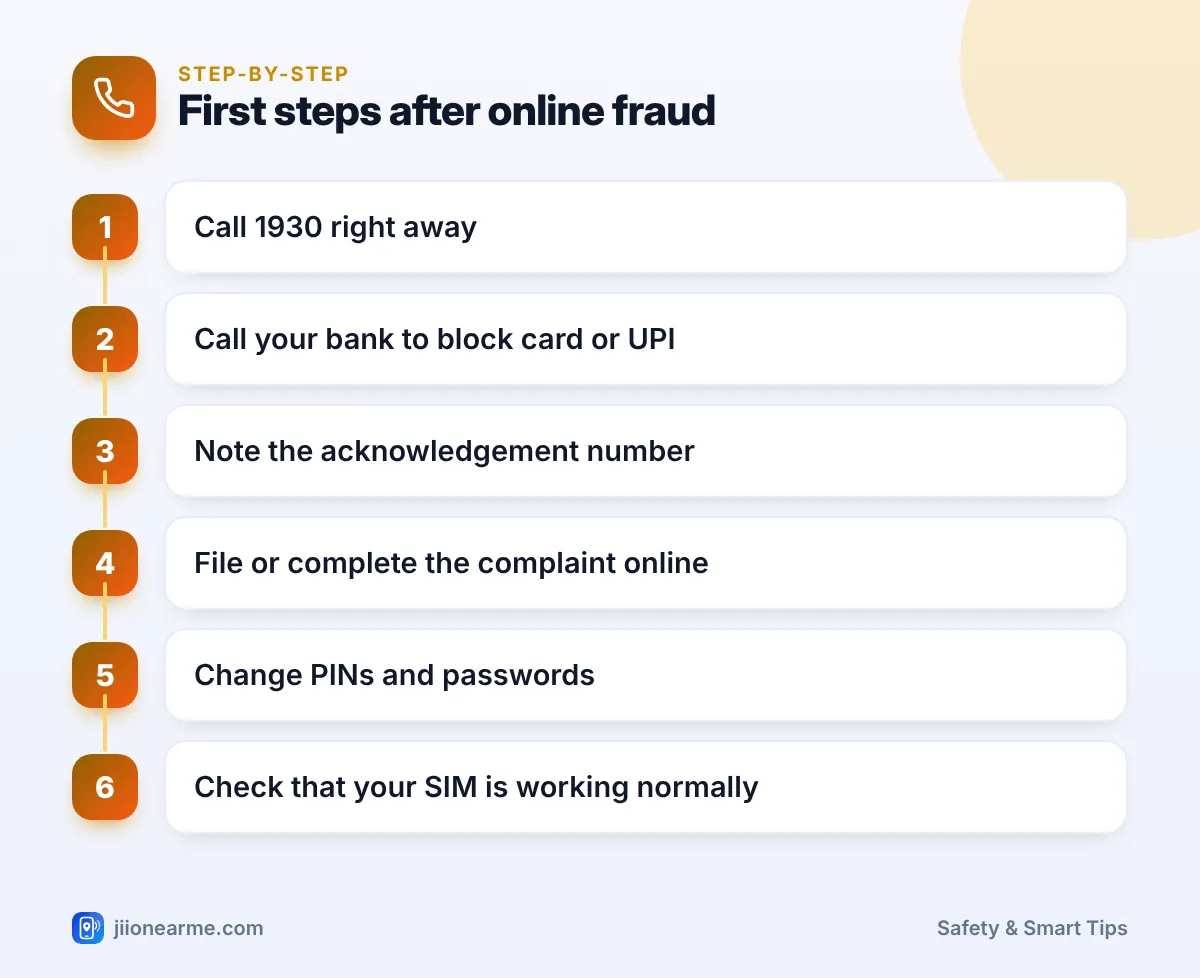
- Call 1930. Say that you are a victim of online financial fraud. Give the details asked for, such as your name, mobile number, bank, transaction details and how the fraud happened.
- Call your bank. Use the helpline number printed on your card, passbook or the bank’s official app. Ask them to block your card, UPI or net banking, and report the transactions as unauthorised.
- Note the acknowledgement number. If the call gives you an acknowledgement or complaint number, write it down. You may be asked to complete the complaint on the portal using it.
- File or complete the complaint online. Go to cybercrime.gov.in and report the financial fraud. The steps are below.
- Secure your accounts. Change your UPI PIN, net banking password and email password from a safe device. Uninstall any app a caller asked you to install.
- Check your SIM. If your Jio SIM suddenly lost network, call the toll-free number 1800-889-9999 from another phone, as a SIM swap may be involved.
How to File a Complaint on cybercrime.gov.in
The National Cyber Crime Reporting Portal is run under the Ministry of Home Affairs. The layout can change, but the steps are broadly these:
- Open cybercrime.gov.in by typing it into your browser yourself.
- Choose the option to file a complaint about cyber crime, and select the financial fraud category when asked.
- Sign in or register with your mobile number. You will receive an OTP. Enter it only on the portal, never share it with anyone.
- Fill in the incident details: date, time, what happened and the platform used, such as a UPI app, bank, website or social media.
- Add the transaction details: bank, transaction ID or UTR, amount and date for each fraudulent transaction.
- Add any suspect details you have, such as phone numbers, UPI IDs, account numbers, website addresses or social media profiles.
- Upload evidence such as screenshots and bank statements.
- Submit and save the acknowledgement number shown on screen or sent to you.
You can track the complaint status on the same portal later. Police may contact you for more information.
Transaction Details to Note Down
Write these down or take screenshots as soon as possible. They make your complaint faster and more accurate.
| Detail | Where to find it |
|---|---|
| UTR or transaction reference number | UPI app history or bank SMS |
| Date and exact time of each transaction | Bank SMS, app or statement |
| Amount of each transaction | Bank SMS or statement |
| Receiver’s UPI ID, account number or wallet | UPI app transaction details |
| Phone numbers that called or messaged you | Call log and chat screenshots |
| Links, apps or websites used | Browser history or messages |
| Your account or card that was debited | Passbook, card or banking app |
Do not delete chats, call logs or SMS from the fraudster, even if they upset you. Take screenshots and keep the originals until your complaint is closed.
Follow Up and Avoid a Second Scam
After reporting:
- Stay in touch with your bank. Ask for a complaint reference and follow up on your dispute.
- Visit the local police station or cyber cell if asked, with printouts of your complaint and evidence.
- Report the fraudster’s number through Chakshu on the Sanchar Saathi portal so it can be checked.
- Beware of recovery scams. Fraudsters often target victims again, pretending to be police, lawyers or “recovery agents”. Real police do not ask for a fee to return your money.
For emergencies where someone is in danger, dial 112. For questions about your Jio plan or SIM, call 199 from your Jio number. Keep 1930 for financial cyber fraud.
Frequently Asked Questions
What if I cannot get through to 1930?
Keep trying, and file the complaint on cybercrime.gov.in straight away so there is no delay. Call your bank’s helpline at the same time.
Will I definitely get my money back?
Recovery is not guaranteed. It depends on how quickly you report, whether the money can still be traced and held, and the banks’ processes. Reporting fast gives you the best chance.
What if the fraud happened a few days ago?
Report it anyway, on 1930 or cybercrime.gov.in, and inform your bank. Late reporting lowers the chance of a hold, but your complaint still matters for the investigation.
Does reporting on Chakshu replace a 1930 complaint?
No. Chakshu is for reporting suspicious calls and messages. If you lost money, call 1930 and file on cybercrime.gov.in.
Can I file a complaint for a family member?
Yes, you can help them report, but keep the victim’s bank and transaction details accurate. The victim may need to confirm details with the bank and police.
Wrapping Up
If money has gone, do not wait: call the cybercrime helpline 1930, call your bank and note every transaction detail. Then complete your complaint on cybercrime.gov.in and keep the acknowledgement number safe. Quick, calm action gives you the best chance of stopping the fraudster and getting help.
JIo Near me is an independent guide and is not affiliated with Reliance Jio. App menus, plans and policies can change – always confirm current details in the official MyJio app or on jio.com. We will never ask for your OTP, PIN or passwords.