There is no such thing as a “digital arrest” under Indian law. Police, customs, the CBI or any other agency do not arrest people over a video call, keep them “under watch” on camera, or ask them to transfer money to clear their name. If someone tells you that you are under digital arrest, it is a scam, and the right move is to end the call.
Yet this scam has cost many families their savings, often targeting older people and professionals who live alone. This article explains how a digital arrest scam unfolds, the tricks that make it feel real, and how to respond and report it.
- No Indian law allows arrest over a video call; “digital arrest” is a scam term.
- Scammers pose as police, customs, CBI or courier officials and use fake uniforms and documents.
- They keep you on camera and isolated, then demand money for “verification”.
- Hang up, talk to family, and verify with your local police station yourself.
- Report on 1930, at cybercrime.gov.in and through Chakshu on Sanchar Saathi.
How a Digital Arrest Scam Unfolds
Most cases follow a script with four stages.
The opening call
It often starts with an automated or live call. Common openings include:
- “A parcel in your name contains drugs, fake passports or illegal items.”
- “Your Aadhaar or mobile number has been used for money laundering.”
- “Your number will be disconnected because it is linked to illegal activity.”
The call is then “transferred” to a so-called police officer or investigator.
The video call
The “officer” asks you to switch to a video call, often on WhatsApp or another video app. You may see a person in uniform, a background that looks like a police station, official-looking logos, and fake documents such as arrest warrants or court orders.
Isolation and fear
You are told you are under “digital arrest” and must stay on camera. They warn you not to tell your family, not to disconnect and not to step out. Some victims are kept on calls for many hours, or even days.
The money demand
Finally, they ask you to transfer money to a “secure government account” for “verification”, promising to return it after the investigation. Once you pay, the money is moved quickly through many accounts and the “officers” disappear.
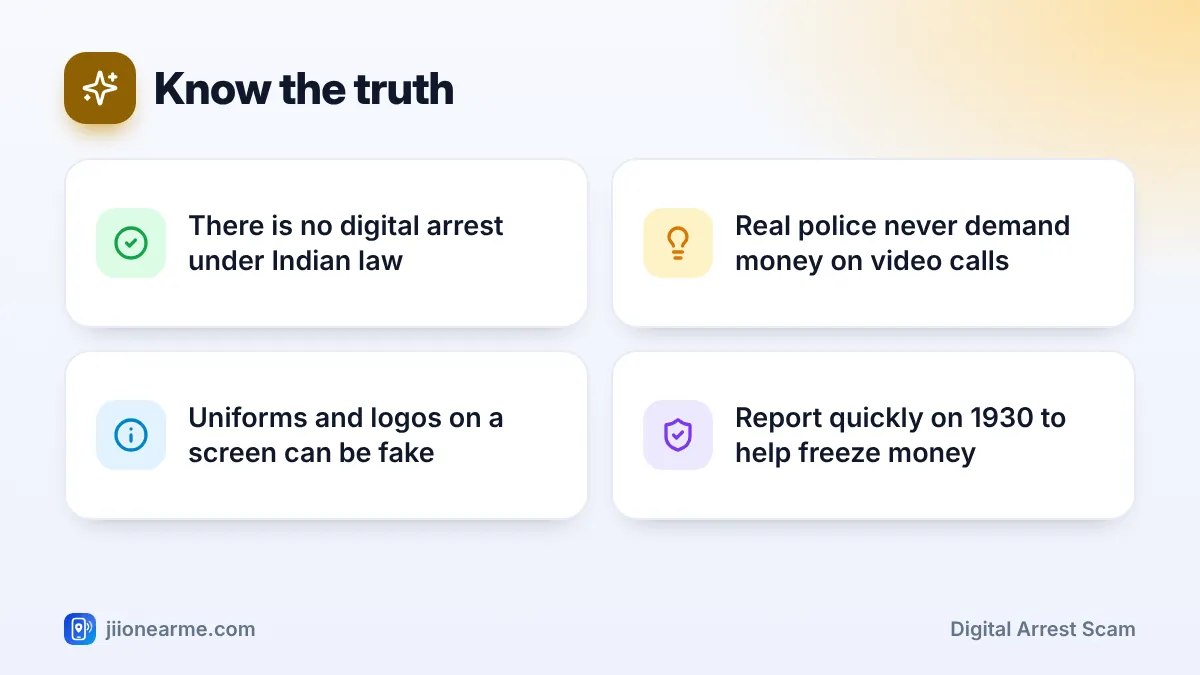
No genuine officer will ask you to stay on a video call as a form of custody, keep the matter secret from your family, or transfer money to prove your innocence. Any one of these is a clear sign of a scam.
Why the Scam Feels So Real
Scammers put real effort into looking official:
- They know your name, address and sometimes your Aadhaar or PAN details, often taken from leaked data.
- They use uniforms, badges, office backgrounds and sounds like wireless radios.
- They send documents with government logos, seals and case numbers.
- They play roles: one person is harsh, while another acts helpful and “on your side”.
- They create time pressure, such as “If you disconnect, police will reach your home in one hour.”
Knowing these tricks helps you stay calm. Anyone can print a logo or wear a uniform on camera.
Digital Arrest Scam vs a Genuine Police Process
| What scammers do | The reality |
|---|---|
| Arrest you over a video call | There is no such thing as a video-call arrest |
| Demand that you stay on camera for hours | There is no “online custody” |
| Ask you to keep it secret from family | Real officers have no reason to isolate you |
| Ask for a money transfer to “verify” funds | No agency asks for money to clear your name |
| Pressure you to act within minutes | Real legal processes can be checked at a police station |
How to Respond If You Get Such a Call
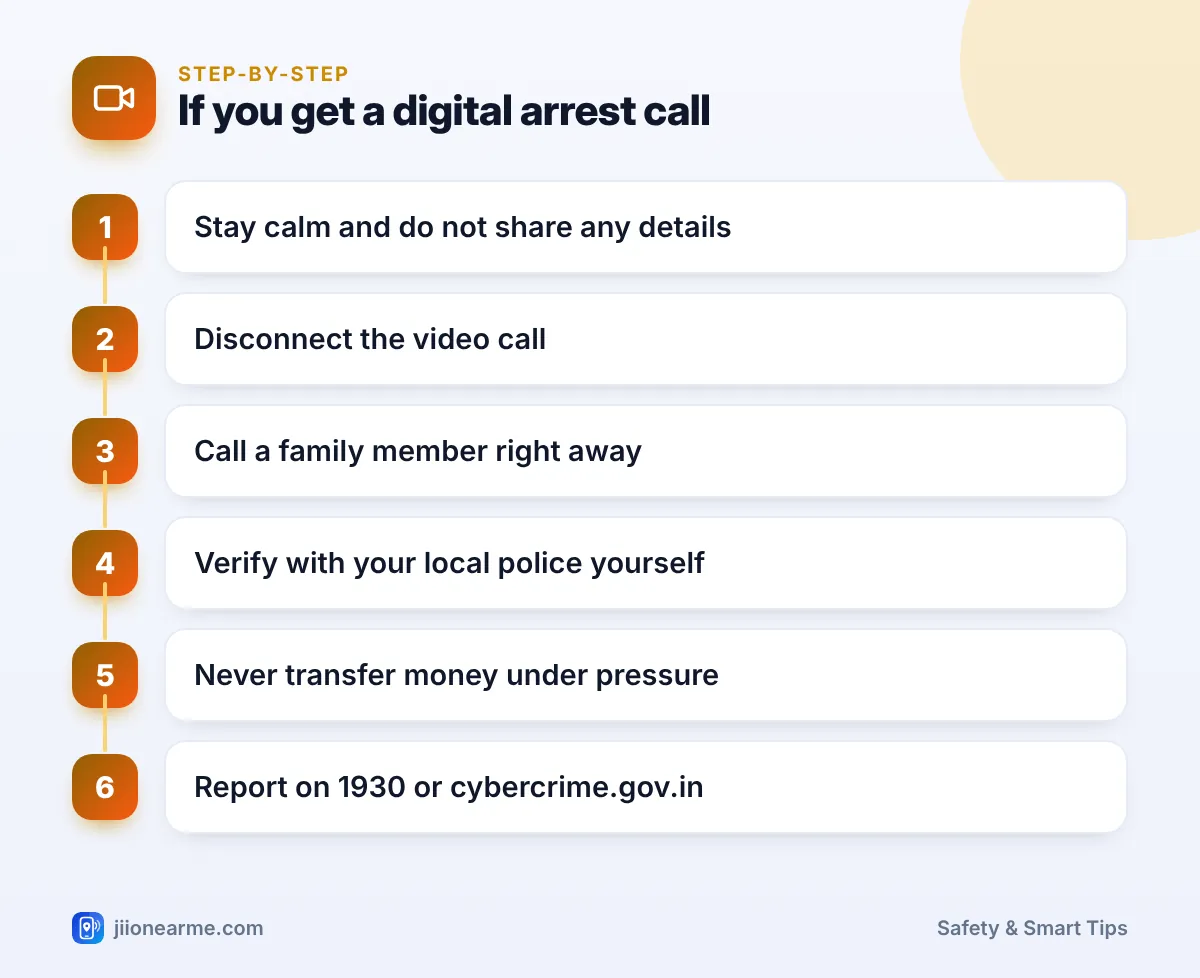
- Stay calm. Fear is the scammer’s main tool.
- Do not share personal or bank details, OTPs, or your Aadhaar or PAN number.
- Disconnect the call. You are not breaking any law by hanging up.
- Talk to a family member or friend immediately. Scammers rely on you staying alone.
- Verify independently. If you are worried, contact your local police station using a number you find yourself, not one the caller gives you.
- Never transfer money, whatever threats are made.
- Report the call, as explained below.
Government awareness campaigns sum up the right response in three words: stop, think, take action.
Agree on a simple family rule: if anyone gets a call about an arrest, the police or a parcel with illegal items, they must call another family member before doing anything else. That one call breaks the isolation that scammers depend on.
How to Protect Your Family
Older parents, people living alone and busy professionals are common targets. A few simple steps help:
- Explain the scam to elderly relatives in plain words, including the typical script.
- Save 1930 and a trusted family member’s number on their phone.
- Tell them clearly that real police do not make video calls to arrest anyone.
- Encourage them to ignore video calls from unknown numbers. On WhatsApp, they can turn on Silence unknown callers under Settings > Privacy > Calls (labels can vary by app version).
- Remind them that it is fine to hang up on anyone, even someone in uniform on a screen.
Where to Report a Digital Arrest Scam
- Lost money? Call the national cybercrime helpline 1930 right away and file a complaint at cybercrime.gov.in. Fast reporting improves the chance of the money being frozen.
- Suspicious call or message? Report it through Chakshu on the Sanchar Saathi portal.
- Local police: You can also visit your nearest police station or cyber cell.
- Bank: Call your bank’s official helpline if you shared account details or made a payment.
Many careful, well-educated people have been tricked by this scam. Reporting quickly matters far more than embarrassment, and it can help stop the same gang from targeting others.
Frequently Asked Questions
Is digital arrest legal in India?
No. Indian law has no provision for a “digital arrest”. Anyone claiming you are under digital arrest is a fraudster.
Can police arrest me through a video call?
No. Agencies do not arrest people or demand money over video calls. If you get such a call, hang up and verify by contacting your local police station yourself.
What if the caller knows my Aadhaar number and address?
Scammers often get personal details from data leaks or earlier frauds. Knowing your details does not make them genuine.
I already transferred money. What should I do?
Call 1930 immediately and file a complaint at cybercrime.gov.in. Also inform your bank so it can try to stop or trace the transaction.
Can I report the number even if I did not lose money?
Yes. Report the call through Chakshu on the Sanchar Saathi portal. This helps authorities act against numbers used for fraud.
Conclusion
A digital arrest scam relies on fear, isolation and speed. Break all three: stay calm, talk to someone you trust, and take your time to verify. No real agency arrests people on a video call or asks for money to clear their name. Make sure every member of your family, especially older relatives, knows this simple fact.
JIo Near me is an independent guide and is not affiliated with Reliance Jio. App menus, plans and policies can change – always confirm current details in the official MyJio app or on jio.com. We will never ask for your OTP, PIN or passwords.