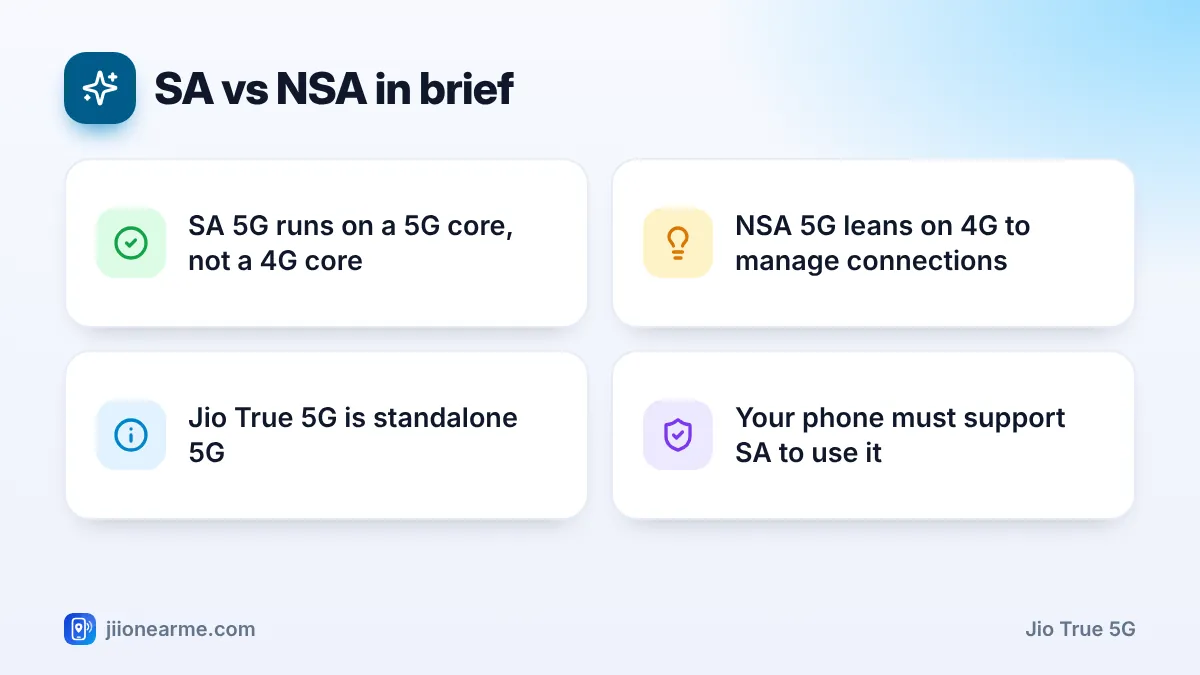
Jio True 5G is Jio’s name for its standalone 5G network. “Standalone” means the 5G network runs on its own 5G core and does not depend on the 4G network to manage your connection. For you, the most practical point is simple: your phone must support standalone (SA) 5G to connect.
The other type, called non-standalone (NSA) 5G, uses a 4G network as its base and adds 5G on top for extra speed. Both approaches are part of the global 5G standards, and both deliver 5G speeds. This explainer covers how they differ, why it matters for your phone and what it changes in daily use.
- Jio True 5G is standalone (SA) 5G, with its own 5G core network.
- Non-standalone (NSA) 5G adds a 5G radio link on top of a 4G network and 4G core.
- Your phone needs SA support plus Jio’s 5G bands, mainly n78 and n28.
- SA does not guarantee higher speed at every spot; signal and crowding still matter.
The Two Parts of Any Mobile Network
To understand SA and NSA, picture a mobile network in two parts:
- The radio network: the towers and antennas that talk to your phone over the air.
- The core network: the “brain” behind the towers. It checks your SIM, manages your sessions, routes your data to the internet and handles calls.
A full 5G network needs both: 5G radio (called New Radio, or NR) and a 5G core. The difference between SA and NSA comes down to which core the 5G radio connects to, and whether 4G stays involved in every session.
Non-Standalone (NSA) 5G Explained
NSA was the quicker way for many operators around the world to launch 5G, because it reuses the existing 4G network.
In NSA mode:
- Your phone first connects to a 4G cell, called the anchor.
- Control signals, such as setting up and managing the connection, travel over 4G.
- When 5G is available, the network adds a 5G radio link for extra data speed.
- Both links connect back to the 4G core.
So NSA works like a 4G network with a 5G speed boost. The phone often keeps both its 4G and 5G radios busy at once. That works well for fast downloads, but it limits newer 5G features that need a 5G core.
Standalone 5G and What Jio True 5G Means
In SA mode, the 5G radio connects to a 5G core. Your phone connects straight to 5G, and the 4G network is not needed to manage the session. Jio describes its True 5G network as standalone, and that independence from 4G is the main idea behind the “True” label.
What a standalone network can offer
- Lower latency potential: with fewer steps through 4G systems, response times can be shorter, which helps gaming and video calls.
- Efficiency: the phone does not need to keep a 4G link and a 5G link active together just to move data.
- Newer 5G features: capabilities such as network slicing (reserving part of the network for a specific use) and voice over 5G, called VoNR, are built around a 5G core.
- Room to grow: future services in the 5G standards assume a standalone core.
Jio also says it uses a mix of low-band (700 MHz, n28) and mid-band (3.5 GHz, n78) spectrum for 5G. The low band reaches further and goes indoors better. The mid band carries more capacity and speed.
SA describes how the network is built. Your actual speed still depends on signal strength, the band you are on, how busy the site is and your phone. An NSA connection with strong signal can be faster than an SA connection with weak signal.
SA vs NSA at a Glance
| Point | Non-standalone (NSA) | Standalone (SA) |
|---|---|---|
| Core network | 4G core | 5G core |
| Needs 4G to connect | Yes, a 4G anchor | No |
| Radios active for data | Often 4G and 5G together | Mainly 5G |
| Voice calls | VoLTE on 4G | VoNR where supported, otherwise moved to 4G VoLTE |
| Advanced 5G features | Limited | Supported by design |
| Phone requirement | NSA support | SA support |
What Jio True 5G Means for Your Phone
This is the part that affects you directly. Early 5G phones did not always support SA, or had it switched off in software. Many brands later added SA support for Indian networks through system updates.
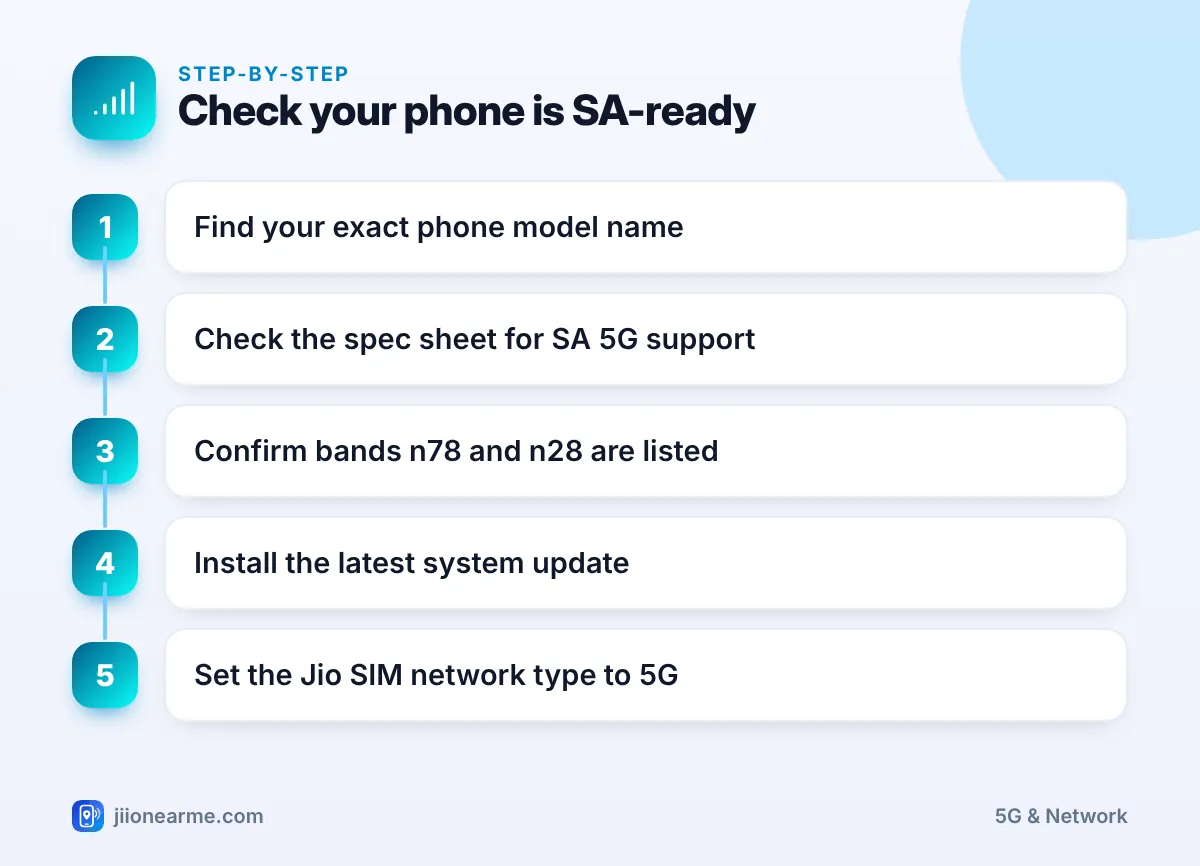
Here is how to check your phone:
- Find your exact model name in Settings > About phone (or General > About on iPhone).
- Open the phone maker’s official spec page and look for “SA” or “SA/NSA” next to 5G.
- Confirm that n78 and n28 appear in the 5G band list.
- Install any pending system update from Settings.
- Set your Jio SIM’s preferred network type to an option that includes 5G.
If a phone supports only NSA, it may never show 5G on Jio, even with the 5G setting turned on.
No app can add SA support that your phone’s modem or software lacks. Third-party tools and hidden dialler codes can change radio settings and cause call or data problems. Use only official system updates from your phone maker.
Calls on a standalone network
On an SA network, voice calls can run over 5G using VoNR, but only where the phone, its software and the network all support it. Otherwise, the phone moves the call to 4G VoLTE when it starts and returns to 5G afterwards. That is why the 5G icon may change to 4G during a call. It is normal and does not mean anything is wrong.
The 5G icon is easier to read
On NSA networks, some phones show a 5G icon while connected to a 4G anchor cell that could add 5G, even when no 5G data is flowing. On a standalone network, the 5G icon generally means you are connected to 5G radio at that moment.
Battery and everyday use
Because an SA phone does not need to hold a 4G data link and a 5G data link together, it can be more efficient than NSA in good coverage. Weak signal still drains battery on any network, so where 5G is poor, letting the phone use 4G is sensible.
Frequently Asked Questions
Is Jio True 5G different from regular 5G?
It is standard 5G, built the standalone way. “True 5G” is Jio’s brand name for its SA 5G network.
Does standalone 5G always mean faster speeds?
No. SA mainly changes how the network is built and what it can support. Day-to-day speed still depends on signal, band, crowding and your phone.
Do I need a new SIM for standalone 5G?
No. Your existing Jio 4G SIM or Jio eSIM works on Jio True 5G. Check your plan’s 5G terms in the MyJio app or on jio.com.
How do I know if my phone supports SA 5G?
Check the maker’s official spec page for “SA” next to 5G, or ask the brand’s support team. Installing the latest system update also matters, because SA support often arrives through updates.
Wrapping Up
Jio True 5G is standalone 5G: a 5G radio network running on its own 5G core rather than leaning on 4G. For most people, the takeaway is practical. Make sure your phone supports SA and Jio’s bands, keep its software updated and set the network type to 5G. After that, signal and coverage shape your experience far more than the label does.
JIo Near me is an independent guide and is not affiliated with Reliance Jio. App menus, plans and policies can change – always confirm current details in the official MyJio app or on jio.com. We will never ask for your OTP, PIN or passwords.
