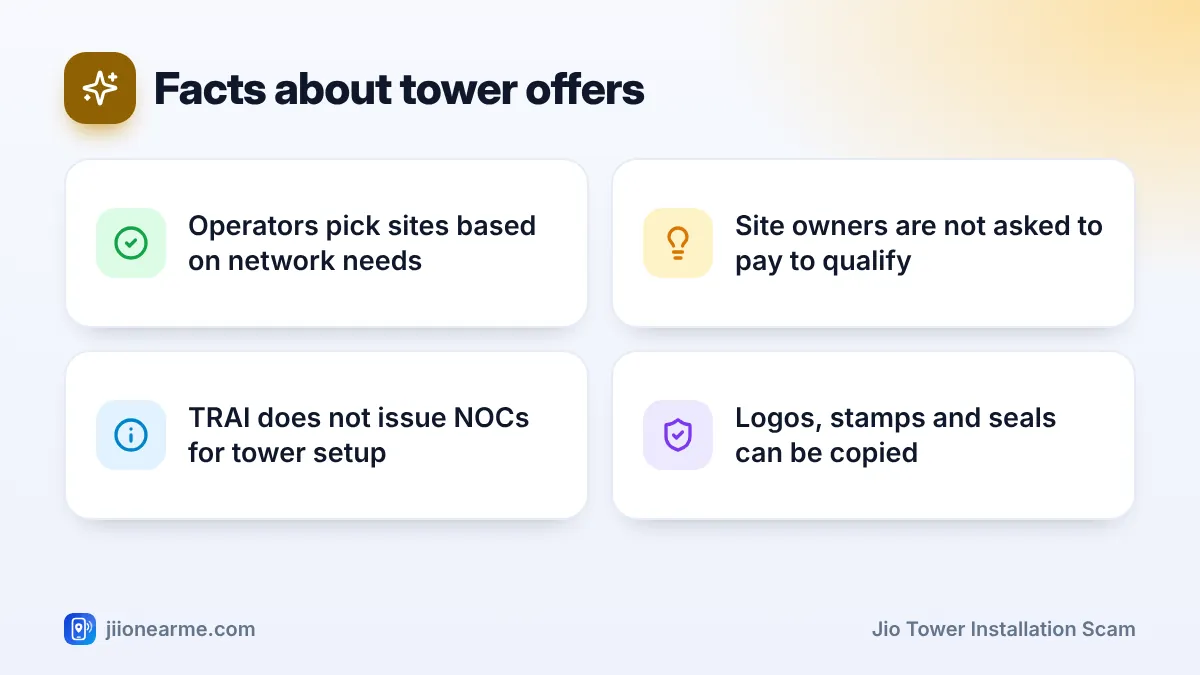
If someone offers you monthly rent for putting a Jio tower on your roof or land, but first asks for a registration fee, deposit or “NOC charge”, you are almost certainly dealing with a scam. Genuine tower sites are chosen by telecom companies based on network needs, and property owners are not asked to pay to be selected.
The sections below explain how the Jio tower installation scam works, the fees fraudsters typically demand, and how you can check any offer before you lose money or hand over documents.
- Tower scams promise high monthly rent, a lump-sum advance or a job for a family member.
- The catch is always an upfront payment: registration, approval, NOC, stamp duty or a “refundable” deposit.
- TRAI has publicly cautioned that it does not issue NOCs for installing mobile towers.
- Never pay money or share Aadhaar, PAN or land papers with an unverified agent.
- Report such offers on cybercrime.gov.in, and call 1930 if you have already paid.
How the Jio Tower Installation Scam Works
This scam is a type of advance fee fraud. You are promised a big benefit later, but you must pay something now. Here is how it usually unfolds.
- The offer reaches you. It may come as an online ad, an SMS, a WhatsApp message, a phone call or a letter on official-looking letterhead. Some people find it themselves while searching online for “tower installation on my land”.
- Your property is “approved”. Soon after you share your address or plot details, you are told your site passed a “survey”. No one has visited, yet the letter says it qualified.
- The rent promise. You are promised attractive monthly rent, an advance for several months, and sometimes a guard or technician job for a family member.
- The first fee. You are asked to pay a registration or processing fee to a bank account or UPI ID.
- More fees follow. Then come charges for an agreement, stamp paper, a “TRAI NOC”, a “radiation clearance”, GST or insurance. Each payment is described as the last one.
- The contact disappears. Once you stop paying or ask questions, the phone is switched off and the website vanishes.
Fraudsters use Jio’s name and logo because it is a well-known brand. The same scam runs in the names of other telecom operators and tower companies too.
Fees and Documents Fraudsters Usually Ask For
These are the most common demands. Seeing any one of them is a strong sign of fraud.
| Demand from the “company” | Why it is a red flag |
|---|---|
| Registration or application fee | Owners are not charged to be considered for a site |
| TRAI or DoT NOC fee | TRAI has said it does not issue NOCs for tower installation |
| Refundable security deposit | A tenant pays the owner, not the other way round |
| Stamp paper or agreement charges by UPI | Agreements are signed in person, not settled by UPI |
| Radiation or survey charges | Technical checks are the operator’s own job |
| Aadhaar, PAN, passbook and land papers on WhatsApp | These can be misused for loans, SIMs or other frauds |
Sending your Aadhaar, PAN, signature, cheque leaf or land papers to an unverified agent can lead to identity misuse long after the tower story ends. Share documents only after verifying the company through official channels, and preferably in person.
How Genuine Tower Sites Are Chosen
Telecom operators and tower infrastructure companies plan sites based on coverage gaps and network demand in a particular area. Their teams identify suitable locations and approach owners when a site is needed there. Towers also need permissions from local authorities, such as the municipal body or panchayat, under local rules.
In simple terms, a genuine company comes to you because it needs your location. You do not apply, pay a fee and wait for approval. If you want to know whether any company is looking for sites near you, ask through official channels instead of answering an ad.
Most people know that big projects need government permission, so a “TRAI NOC fee” sounds believable. TRAI has issued public cautions saying it does not issue such NOCs for mobile towers, so any demand for this fee is fake.
How to Verify a Tower Installation Offer
Before you take any step, run through this list.
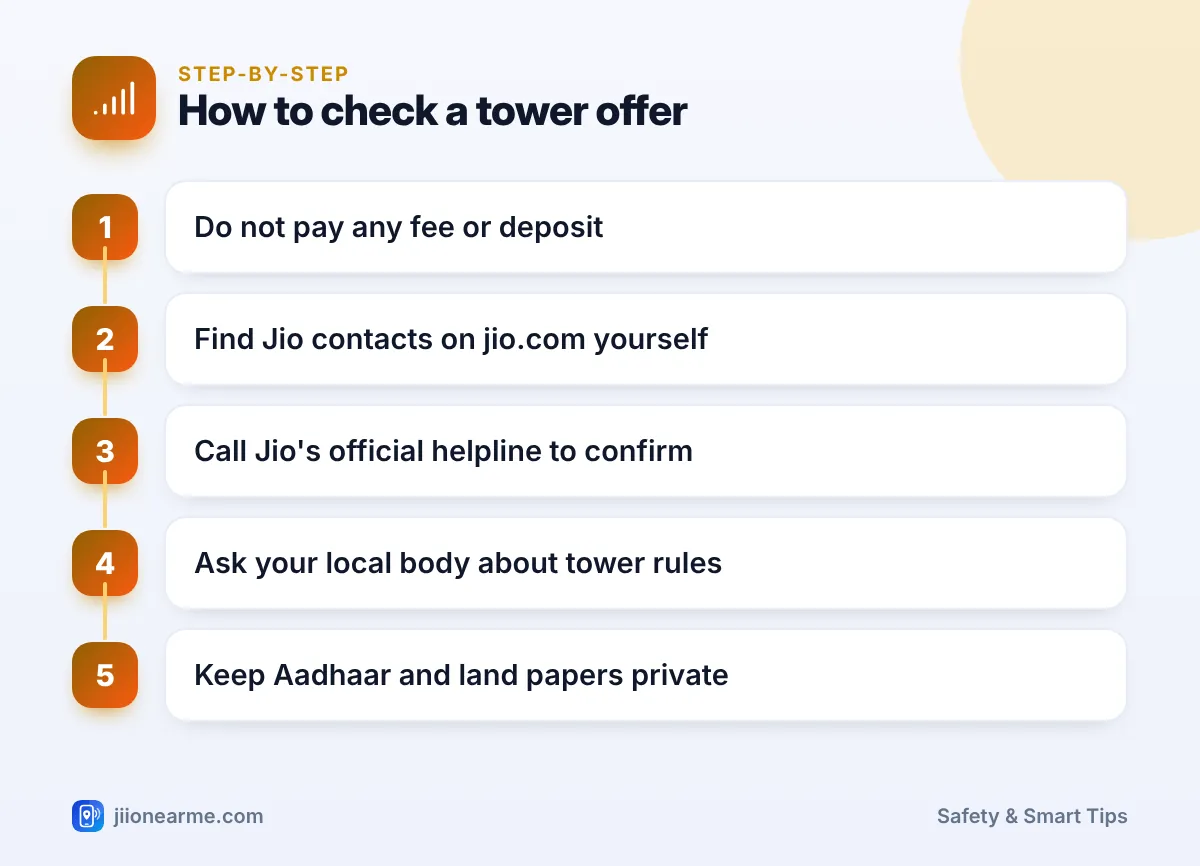
- Do not pay anything. Hold all payments until you have checked the offer independently.
- Look up contact details yourself. Type jio.com into your browser and use only the contact options listed there. Do not trust numbers, emails or websites printed in the letter.
- Call official customer care. Call the Jio toll-free number 1800-889-9999, or 199 from a Jio number, and ask how to confirm whether such an offer is genuine.
- Check the website address. Fake sites often use addresses with extra words like “tower”, “install” or “rent” and unusual endings. Jio’s official website is jio.com.
- Check the email address. A free email service or a strangely spelled domain is a warning sign.
- Ask your local body. Your municipal office or panchayat can explain what permissions a tower would actually need in your area.
- Talk to someone you trust. A family member, lawyer or local official can often spot the problem quickly.
Search online for the exact phone number or company name used in the offer along with the word “fraud”. Many victims post warnings, and you may find the same script reported by others.
What to Do If You Already Paid
Act quickly, because fraudsters move money fast.
- Call the national cybercrime helpline 1930 and report the payment.
- File a complaint on cybercrime.gov.in with screenshots, letters, receipts and the phone numbers used.
- Inform your bank and share the transaction reference or UTR number.
- If you shared Aadhaar or PAN, watch for any loan, SIM or account opened in your name. You can check mobile connections issued against your identity on the Sanchar Saathi portal.
- Report the calling number and messages through Chakshu on Sanchar Saathi.
Do not pay anyone who promises to “recover” your lost money for a fee. That is often the same gang trying again with a new story.
Frequently Asked Questions
Does Jio pay rent for towers on private property?
Telecom companies do lease sites from property owners when they need a location. But they approach owners based on network planning, and owners are not asked to pay registration or approval fees.
Is a TRAI NOC needed to install a mobile tower?
TRAI has publicly said it does not issue NOCs for mobile tower installation. A demand for a “TRAI NOC fee” is a clear sign of fraud.
The letter has a Jio logo and a stamp. Is it genuine?
Logos, stamps and signatures are easy to copy. Verify by contacting Jio through details you find yourself on jio.com, not through anything printed in the letter.
Where can I report a fake tower installation offer?
Report it on cybercrime.gov.in, or call 1930 if you lost money. You can also report the calls and messages through Chakshu on the Sanchar Saathi portal.
Summary
The Jio tower installation scam lives on one promise: easy rent in exchange for a small fee now. Real tower deals do not work that way. Keep your money and documents with you, verify every offer through official contacts you look up yourself, and report the fraudsters so that others in your area are warned too.
JIo Near me is an independent guide and is not affiliated with Reliance Jio. App menus, plans and policies can change – always confirm current details in the official MyJio app or on jio.com. We will never ask for your OTP, PIN or passwords.