The short answer from health authorities is that radio-frequency exposure below international guideline limits has not been shown to harm health, and India’s limits for mobile towers are set lower than those international guidelines. 5G uses the same type of radio waves as 4G, Wi-Fi and FM radio. These are non-ionising waves, which means they do not carry enough energy to damage DNA the way X-rays can.
Concern about towers is understandable, especially when a new site appears near your home. This explainer covers what EMF is, how India’s limits are set and checked, and where you can look up official information for your area instead of relying on forwarded messages.
- 5G, like 4G and Wi-Fi, uses non-ionising radio-frequency (RF) waves.
- The WHO says no adverse health effect has been causally linked to wireless technologies when exposure stays within guideline limits.
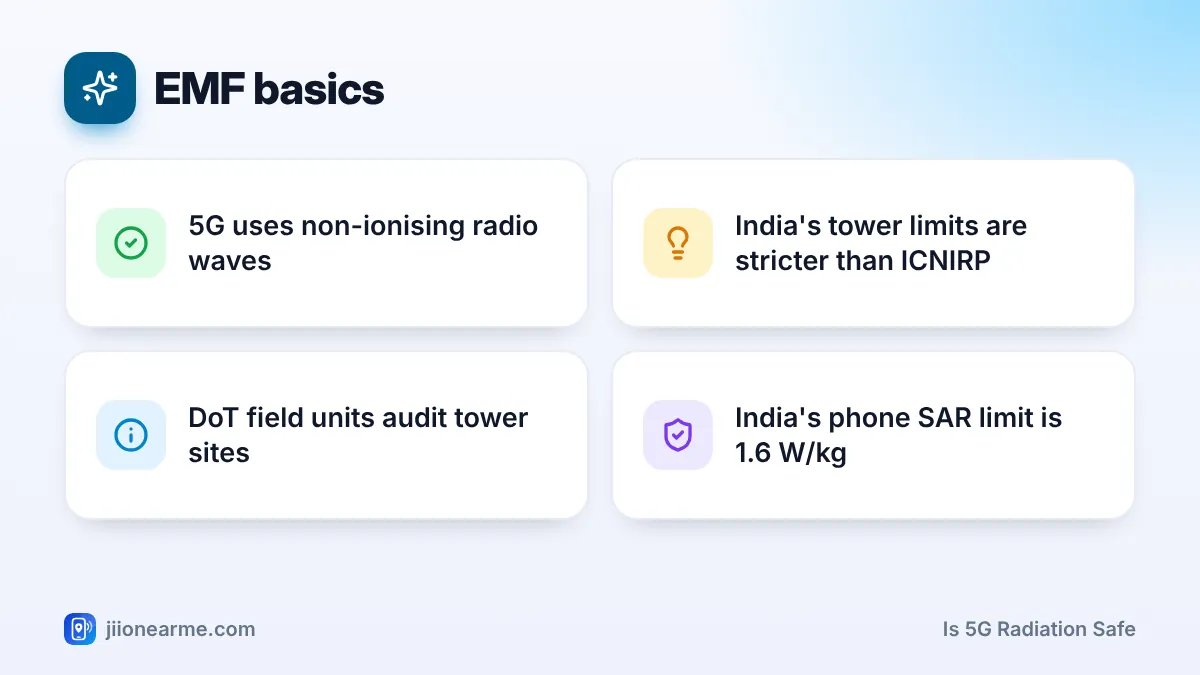
- India’s exposure limit for mobile towers is one-tenth of the level in the ICNIRP international guidelines.
- You can see towers near you and their EMF compliance status on the DoT’s Tarang Sanchar portal.
What Is Radio-Frequency EMF?
EMF stands for electromagnetic fields. Radio-frequency (RF) EMF is the energy that radio, TV, Wi-Fi, Bluetooth and mobile networks use to carry signals through the air.
The key word is non-ionising. Radiation such as X-rays and ultraviolet light is ionising, meaning it has enough energy to break chemical bonds and damage cells. RF waves have far less energy per wave. The main known biological effect of strong RF energy is mild heating of body tissue, and exposure limits are set well below the level where heating becomes a concern.
5G does not use a new or different kind of radiation. Jio’s 5G mainly runs on bands such as n28 (700 MHz) and n78 (around 3.5 GHz), which sit in the same broad part of the radio spectrum as earlier networks and Wi-Fi.
Is 5G Radiation Safe? What Health Bodies Say
The World Health Organization (WHO) has said that, after much research, no adverse health effect has been causally linked with exposure to wireless technologies. It adds that no public health consequences are expected as long as overall exposure stays below international guidelines.
You may also come across the fact that the WHO’s cancer research agency, IARC, placed RF fields in Group 2B, “possibly carcinogenic”, in 2011. That category is used when evidence is limited and a risk cannot be fully ruled out. It does not mean a link has been shown. Research continues, and large reviews of the evidence, including work commissioned by the WHO, have not found that mobile phone use causes brain cancer.
RF energy weakens rapidly with distance. People at ground level near a tower are usually exposed to a small fraction of the limit, because antennas send most of their energy outward towards the horizon rather than straight down.
How India’s EMF Limits Are Set
Limits for mobile towers
Many countries follow guidelines from ICNIRP, the International Commission on Non-Ionizing Radiation Protection. India’s Department of Telecommunications (DoT) first adopted these and later, in 2012, tightened the limit for base station exposure to one-tenth of the ICNIRP reference level. In other words, India’s tower limits are stricter than the international guideline.
Limits for mobile phones
For handsets, safety is measured as SAR (Specific Absorption Rate), the rate at which the body absorbs RF energy. India’s limit is 1.6 W/kg averaged over 1 gram of tissue, which is also stricter than the international guideline that averages over a larger amount of tissue. Phone makers must meet this limit for phones sold in India. You can usually find a phone’s SAR value in its manual, on the box or in the About phone section of Settings. On many phones, dialling *#07# also shows it, though this may not work on every model.
How Compliance Is Checked
Rules are only useful if they are enforced. In India:
- Self-certification: operators must certify to the DoT that each tower site meets the EMF limits.
- Audits: DoT field units test a share of sites with measuring equipment to check that they comply.
- Penalties: sites that break the limits can attract penalties and must be fixed or shut down.
- Public requests: anyone can request an EMF measurement for a site through the Tarang Sanchar portal. A fee applies, so check the current amount on the portal.
The Tarang Sanchar portal (tarangsanchar.gov.in) is run by the DoT. It shows tower sites on a map and their compliance status. It covers all operators, not just Jio.
Check the towers near you
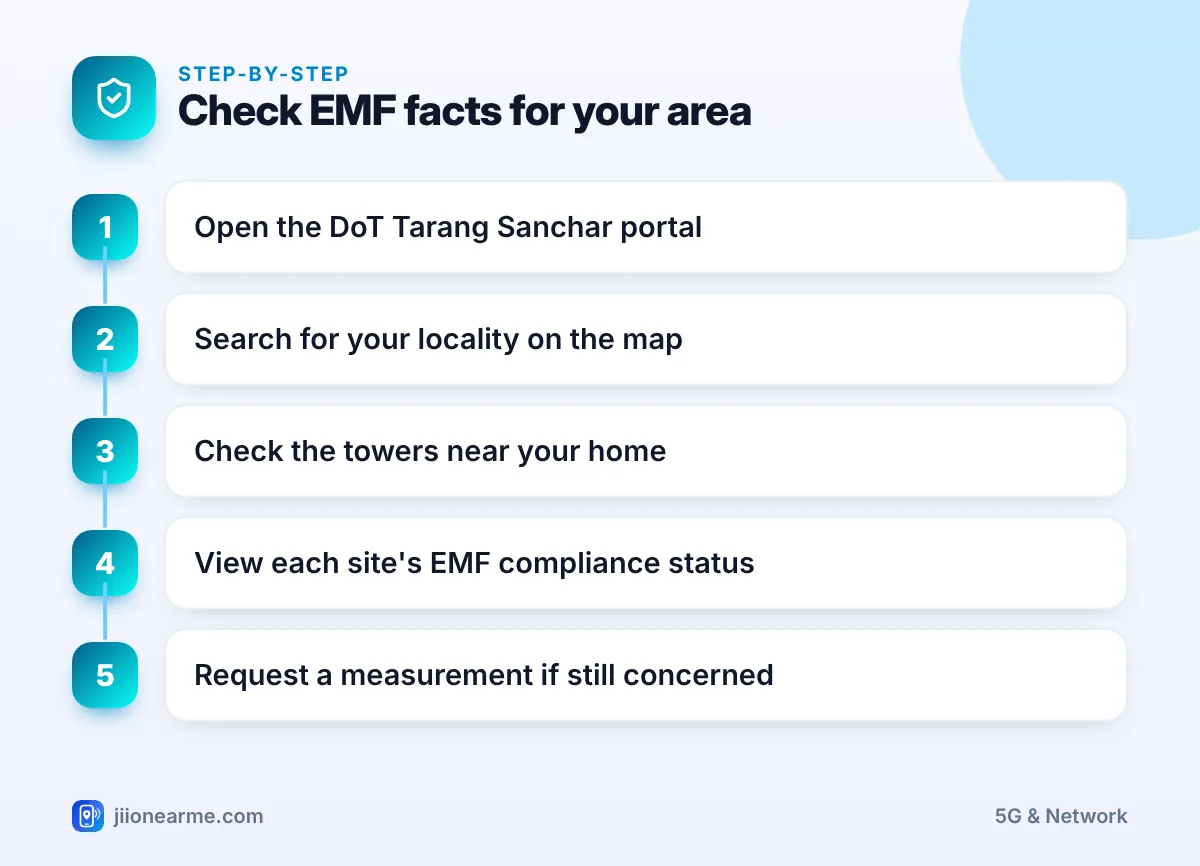
- Open the Tarang Sanchar portal in your phone or computer browser.
- Use the map or the search option to find your locality.
- Select a tower marker near your home to see its details.
- Look at the EMF compliance status shown for that site.
- If you still have concerns, use the option to request an EMF measurement.
Practical Ways to Lower Your Own Exposure
If you want to reduce exposure further, the biggest factor is usually your own phone, not the tower. These habits help:
- Use speakerphone or wired earphones for long calls, so the phone is away from your head.
- Prefer calls in good signal. A phone transmits at higher power when signal is weak. Better coverage often means lower output from your handset.
- Use Wi-Fi Calling at home if indoor signal is poor and you have a good Wi-Fi connection.
- Text or use messaging instead of long calls when you can.
Stickers and cases that claim to block phone radiation can weaken your signal, which may make the phone transmit harder. Also be careful of calls or messages offering large rent or advance payments to install a mobile tower on your property. These are often scams. Report fraud to the national cybercrime helpline 1930 or at cybercrime.gov.in.
Frequently Asked Questions
Is 5G more dangerous than 4G?
No evidence shows that. 5G uses non-ionising radio waves, like 4G, and must meet the same exposure limits in India. The type of energy is the same; only how the network uses it differs.
Is it safe to live near a mobile tower?
Sites must stay within India’s limits, which are stricter than international guidelines. You can check towers near your home and their compliance status on the Tarang Sanchar portal.
Do 5G phones have higher SAR?
Not necessarily. Every phone sold in India must stay within the SAR limit, whether it supports 4G or 5G. Check your model’s SAR value in its manual or settings.
Who should I contact about a specific tower?
For EMF concerns, use the Tarang Sanchar portal to view the site and, if needed, request a measurement. For network or coverage questions about Jio, call 199 from your Jio number.
Final Thoughts
Based on current evidence and the views of health authorities, everyday exposure from 5G networks within India’s limits is not considered a health risk. India’s tower limits are stricter than the international guideline, and sites are certified and audited. If you still have concerns, check the official data for your area on the Tarang Sanchar portal rather than forwarded messages, and use simple habits like speakerphone for long calls.
JIo Near me is an independent guide and is not affiliated with Reliance Jio. App menus, plans and policies can change – always confirm current details in the official MyJio app or on jio.com. We will never ask for your OTP, PIN or passwords.
