Most first bills on Jio postpaid do not cover a neat, full month, and that is the main reason yours may look different. Your connection starts on one date, but your billing cycle may close on another. The first bill also picks up one-time items that will not appear again.
So a first bill can be lower or higher than your plan charge without anything being wrong. This guide explains pro-rata charges, one-time items and the role of your plan start date, and shows you how to check the bill line by line.
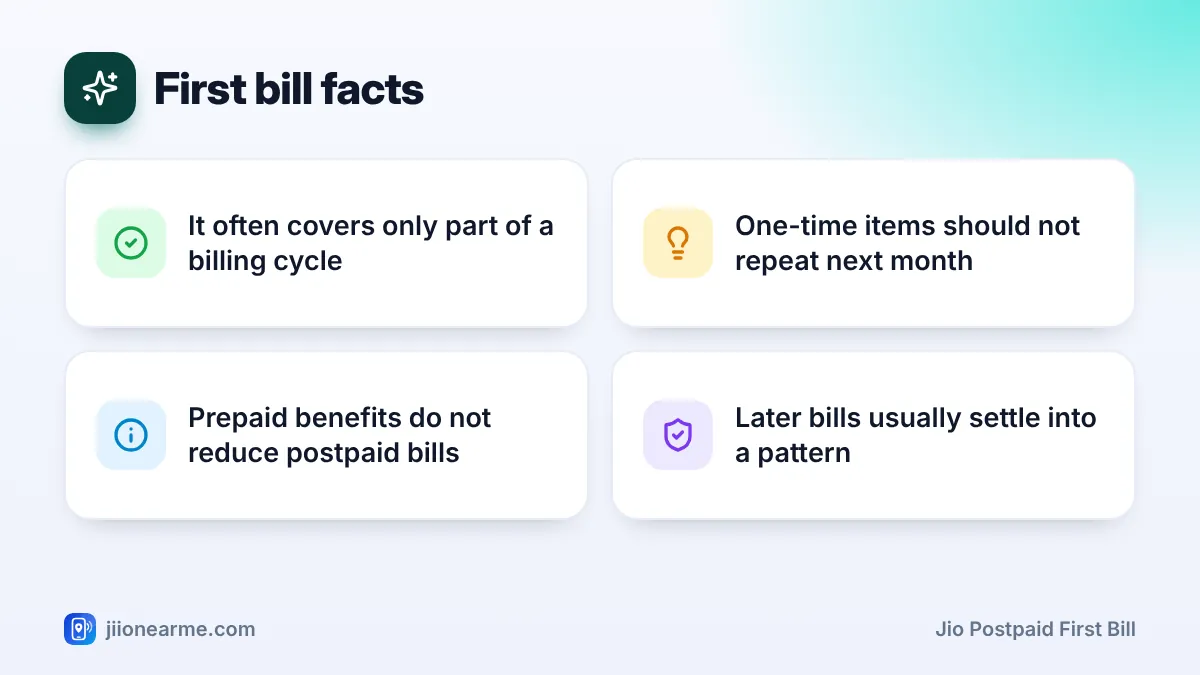
- The first bill usually covers the days from activation to your first bill date.
- Part-month plan charges are called pro-rata charges.
- One-time items, such as setup-related charges, appear only on the first bill.
- Packs, roaming or family members added in the first weeks also affect it.
- From the second bill, charges usually follow a steadier monthly pattern.
Why the Jio Postpaid First Bill Is Rarely a Full Month
When your postpaid connection starts, your account is placed on a billing cycle. The cycle has a fixed bill date each month. Your activation date, however, can fall on any day.
Here is an example with illustrative dates only. Suppose your connection started on the 20th, and your account’s bill date is the 1st of each month.
- Your first bill, generated on the 1st, covers about 11 or 12 days of service.
- Your second bill covers a full cycle, from the 1st to the end of that month.
- From then on, each bill covers one full cycle.
In this case, the first bill could be smaller than a normal month’s bill. If your activation date falls just after a bill date, the first bill covers nearly a full cycle instead.
Pro-Rata Charges Explained Simply
Pro-rata means “in proportion”. For a part-month, the plan charge is usually worked out in proportion to the days you had the plan.
The general idea looks like this:
Part-month charge = monthly plan charge × days on the plan ÷ days in the billing cycle
Exact methods can vary, so treat this as a way to understand the line, not a calculator for your bill. The bill usually shows the dates for each part-month charge, which helps you check it.
Depending on how plan charges are billed for your account, the first bill may also include the plan charge for the next full cycle. If you see two plan lines with different date ranges, that is likely the reason. The second bill then looks lower than the first.
In some cases, the plan’s benefits for a part-month may also be adjusted. Check your plan details and usage in MyJio during the first few weeks, so you know what you actually have.
One-Time Items That Appear Only Once
Your first bill can include items linked to starting the connection. These should not repeat on later bills. Depending on your situation, they can include:
| Item | Why it may appear | Will it repeat? |
|---|---|---|
| Setup or SIM-related charges | Linked to starting the connection, if applicable | No |
| Security deposit adjustment | If a deposit is billed or adjusted, depending on your account | No |
| Packs bought in the first weeks | Data, roaming or other packs you added | Only if you buy again |
| Family member additions | Part-month charges for new add-on members | No, full charges from next cycle |
| Taxes | Added to all charges on the bill | Yes, on every bill |
Not every bill will have all of these. If a one-time item appears again on your second bill, ask customer care about it.
How Your Plan Start Date Shapes the Bill
The date your plan starts affects more than the number of days billed.
If you switched from prepaid
When a prepaid number moves to postpaid, unused prepaid benefits usually do not reduce your postpaid bill. Your postpaid charges start from the conversion date, so the first bill covers only the days after that.
If you added family members
On a JioPlus family plan, each add-on member may show a part-month charge from the day they joined. Members who joined on different days may show different amounts.
If you changed plans early
A plan change in the first cycle can add a second set of part-month charges. Both the old and new plan lines may appear on the first bill.
How to Check Your Jio Postpaid First Bill Line by Line
Go through the bill in this order. Labels in MyJio and on the bill may differ slightly by version.
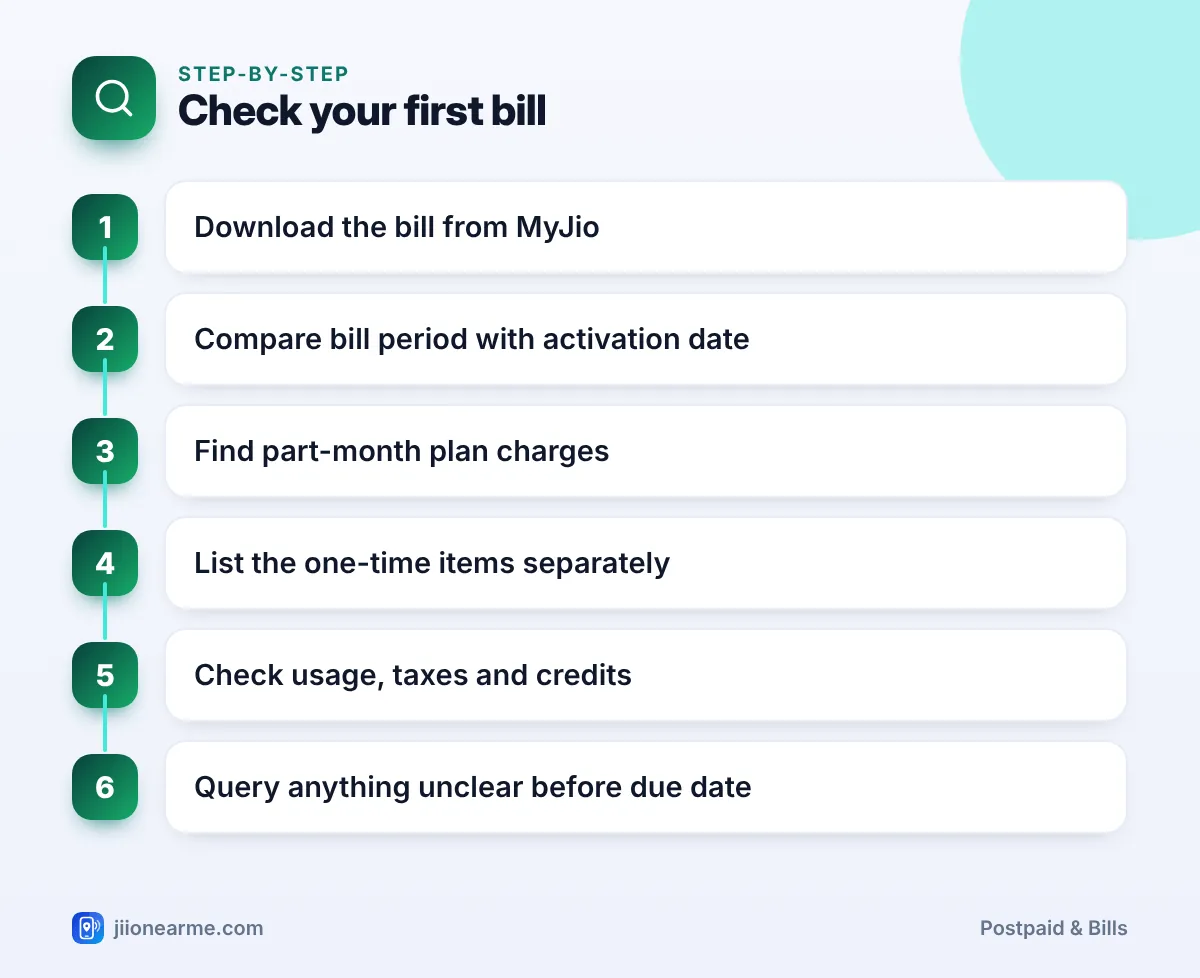
- Download the bill from your bills or postpaid account section in MyJio.
- Compare the bill period with your activation date. This explains most of the difference.
- Find the plan charge lines and their date ranges.
- List one-time items separately, so you know what will not repeat.
- Check usage, taxes and credits, including any extra usage or packs.
- Query anything unclear with customer care before the due date.
Your second bill is usually a better guide to your normal monthly cost. Compare it with your plan charge and usage, and decide then whether your plan size is right.
When to Question a Charge
Most first-bill differences have a simple reason. Still, ask customer care if you see:
- A plan you did not choose, or the wrong family members listed.
- A one-time charge you were not told about.
- Usage charges for services you did not use.
- A payment you made that is missing from the bill.
Call 199 for queries or 198 to register a complaint from your Jio number, or 1800-889-9999. You can also check your account on jio.com. Raise the issue before the due date and keep your bill number ready.
Even if you are questioning a charge, keep the due date in mind. Ask customer care how to handle the disputed part, so the rest of the bill is not paid late.
Frequently Asked Questions
Why is my first Jio postpaid bill lower than my plan charge?
Your first bill may cover only a few days of service, from activation to your first bill date. The plan charge is then usually charged in proportion to those days.
Why is my first bill higher than expected?
It may include one-time items, packs bought early, family member additions or, depending on your account, the plan charge for the next cycle as well.
Will my second bill be the same as the first?
Usually not. The second bill typically covers a full cycle without one-time items, so it is a better guide to your normal monthly cost.
Do unused prepaid benefits reduce my first postpaid bill?
Generally no. Unused prepaid benefits usually do not carry over when you switch to postpaid.
Where can I see the dates for each charge?
The bill usually shows date ranges next to part-month charges. Download the bill PDF from MyJio to see the full details.
Final Thoughts
A Jio postpaid first bill looks different because it is built differently. It often covers a part-month, includes one-time items, and reflects anything you set up in your first few weeks.
Compare the bill period with your activation date, separate the one-time items, and use the second bill as your real benchmark. If anything still does not add up, ask customer care before the due date.
JIo Near me is an independent guide and is not affiliated with Reliance Jio. App menus, plans and policies can change – always confirm current details in the official MyJio app or on jio.com. We will never ask for your OTP, PIN or passwords.