If you’re planning a trip to India, one of the first practical decisions you’ll face is eSIM vs physical SIM — and it’s a bigger decision than it sounds. Your choice affects how much time you spend at the airport, whether you need to carry ID documents for verification, and even how reliable your connection is during the trip. This article breaks down the real differences so you can decide before you land, not after you’re stuck in a queue.
What’s the Actual Difference?
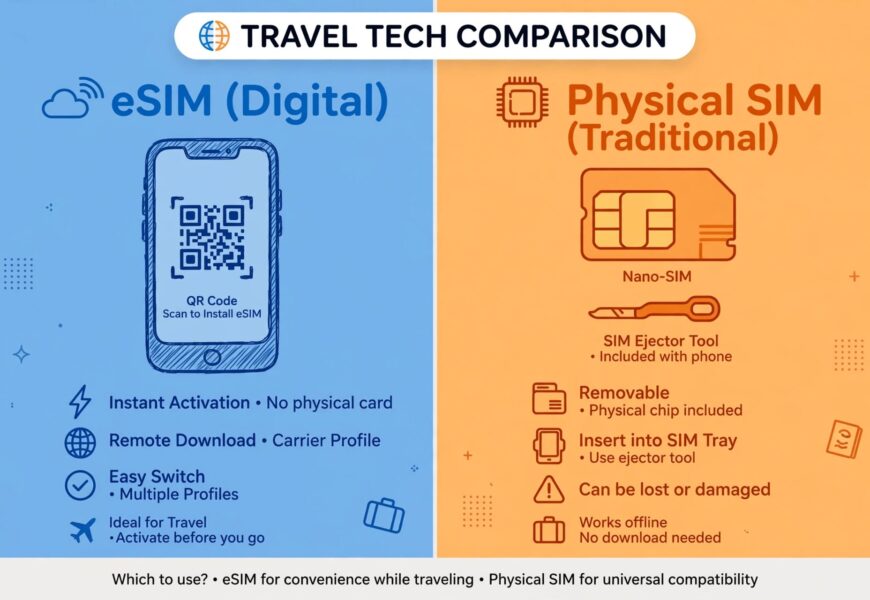
A physical SIM is the small plastic chip you insert into your phone’s SIM tray, purchased either before your trip or from a kiosk after arrival. An eSIM is a digital profile installed directly onto your phone’s embedded chip — no plastic card, no tray, just a QR code you scan to activate. Both connect you to the same Indian mobile networks; the difference is entirely in how you get connected. If you want the bigger picture on how India’s tourist eSIM ecosystem works, our complete India eSIM guide covers the fundamentals.
Setup and Activation Time
This is where the two options diverge the most. A physical SIM typically requires:
- Finding a telecom kiosk or authorized retailer (often not available 24/7 at smaller airports)
- Submitting passport copies and, in many cases, a local address or hotel booking confirmation
- Waiting for manual verification, which can take anywhere from 30 minutes to a full day depending on the operator
- Physically swapping the SIM card into your phone
An eSIM, by contrast, is typically purchased online before you even board your flight. The QR code arrives by email, and activation takes about two to five minutes once you land and connect to airport Wi-Fi. There’s no physical exchange, no waiting in line, and in most cases, no KYC document upload at all.
KYC and Documentation Requirements
India’s telecom regulations require identity verification (KYC) for physical SIM purchases, which exists to prevent fraud and misuse but adds friction for short-term visitors. Many dedicated tourist eSIM providers sidestep this requirement entirely by operating under international data-roaming frameworks rather than local prepaid registration rules — which is why you’ll often see “No KYC Required” listed as a selling point. We explain how this works in more detail in our guide to buying an eSIM without KYC in India.
Cost Comparison
Pricing depends heavily on your trip length and data needs:
- Physical SIMs from local carriers often have lower per-GB rates for long stays, but may include setup or activation fees, and require you to pay for a full validity period even if you only need a few days.
- eSIMs from tourist-focused providers are usually priced in short-duration bundles (7, 15, or 30 days) that match typical trip lengths, so you’re not overpaying for unused validity.
For a full pricing breakdown across providers, see our article on India eSIM cost and pricing.
Network Reliability
Here’s a common misconception: eSIMs are not a separate network — they connect to the same physical towers as regular SIM cards. An eSIM from a provider partnered with a major Indian carrier like Airtel or Jio will perform identically to a physical SIM on that same network. The real reliability difference comes down to which carrier’s infrastructure your eSIM is provisioned on, not the eSIM format itself. Our comparison of Airtel, Jio, and Vi networks can help you understand which underlying network offers the best coverage for your specific destinations.
Keeping Your Home Number Active
One major advantage of eSIM for tourists: most modern smartphones support dual SIM functionality, meaning your physical home SIM stays in the tray for calls, SMS, and banking OTPs, while the eSIM handles local data. This is far more convenient than removing your home SIM and risking losing it, which is a real concern with the physical-swap approach. Apple’s support documentation on eSIM while traveling explains how this dual-connectivity setup works on iPhone specifically.
Device Compatibility Caveat
Not every phone supports eSIM. Before deciding, verify your device is compatible — this matters more than the eSIM-vs-physical decision itself, since an incompatible phone makes the choice for you. The GSMA’s eSIM technology overview has background on which device categories generally support the feature.
Which Should You Choose?
| Factor | eSIM | Physical SIM |
|---|---|---|
| Setup speed | 2–5 minutes | 30 min–1 day |
| KYC required | Usually no | Usually yes |
| Best for | Trips under 30 days | Long stays, best local rates |
| Risk of loss | None (digital) | Card can be lost/damaged |
| Device requirement | eSIM-compatible phone | Any unlocked phone |
Bottom line: For most tourists visiting India for two to four weeks, an eSIM is the faster, lower-friction option. If you’re relocating for months or need the absolute lowest per-GB cost, a physical SIM from a local carrier may still make sense.
Frequently Asked Questions
Can I use eSIM and physical SIM at the same time in India?
Yes, as long as your phone supports dual SIM (physical + eSIM), which most phones released after 2019 do.
Is eSIM more expensive than a physical SIM in India?
Not necessarily — for short trips, eSIM bundles are often cheaper since you’re not paying for unused long-term validity.
What happens if my eSIM doesn’t work after landing?
Most reputable providers offer 24/7 support via chat or email. Always activate your eSIM profile before you fly, even if you don’t turn on data until you land.
