Why does a “monthly” Jio recharge run out before the month is over? Because most Jio prepaid plans use 28-day validity, which is exactly four weeks, not a calendar month. Since a year has 365 days, these cycles add up to 13 recharges a year instead of 12.
This is common across Indian telecom operators, not something unique to Jio. Once you understand how day-based validity works, it becomes much easier to compare plans, set reminders and decide whether a 30-day or calendar-month option suits you better.
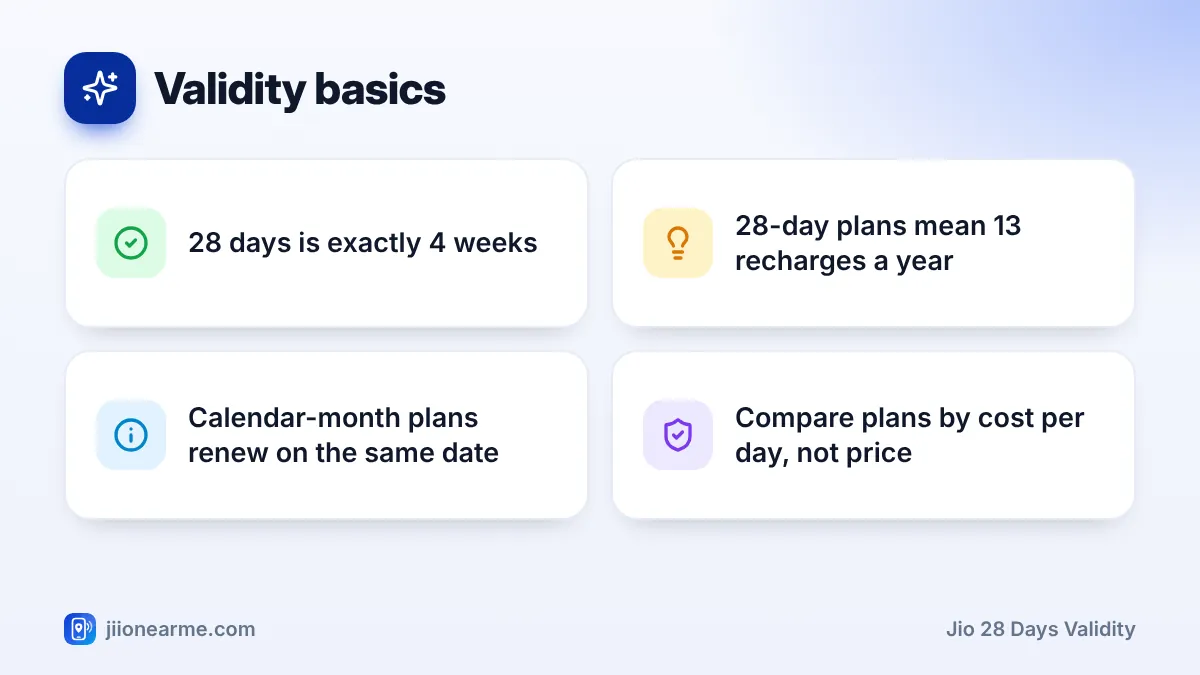
- A 28-day plan lasts exactly four weeks, so your due date moves earlier each month.
- Thirteen 28-day cycles cover 364 days, which means 13 recharges a year.
- A calendar-month plan renews on the same date every month, so you recharge 12 times a year.
- A 30-day plan is close to a month but is still counted in days.
- Compare plans by cost per day and yearly cost, not by the price on the label.
What 28-Day Validity Really Means
Validity is the number of days your plan stays active. On a 28-day plan, the count starts when the plan activates and ends exactly 28 days later. It does not care how many days the current month has.
So if your plan starts on the 1st of a 31-day month, it ends before the month is over. Your next recharge falls a few days earlier in the next month, and the date keeps moving back. This is why many people feel their “monthly” plan ends too soon.
How Jio 28 Days Validity Works Across a Year
The maths is simple. Four weeks multiplied by 13 gives 52 weeks, or 364 days. That means:
- You need about 13 recharges a year on a 28-day plan.
- Your due date moves a few days earlier in most months.
- A plain monthly reminder will slowly fall out of sync with your real expiry date.
Here is how common validity types compare across a year:
| Validity type | Recharges in a year | How your due date behaves |
|---|---|---|
| 28 days | 13 | Moves a few days earlier most months |
| 30 days | About 12, with a few days left over | Drifts slightly over the year |
| Calendar month | 12 | Same date every month |
| 84 days | About 4 to 5 | Moves earlier over the year |
| Around a year | 1 | Once a year, if exactly 365 days |
A 28-day plan lines up perfectly with a calendar reminder that repeats every 4 weeks. For an 84-day plan, set it to repeat every 12 weeks.
Why Plans Use 28-Day Cycles
Day-based validity has been standard on Indian prepaid plans for years, and 28 days is one of the most common cycles. It equals exactly four weeks, which keeps plan structures simple when benefits such as data are given per day.
For you, the practical effect is the extra recharge each year. That is not a hidden charge, but it does mean the yearly cost of a 28-day plan is higher than its price multiplied by 12. Keep this in mind whenever you compare a 28-day plan with a plan of a different length.
What Calendar-Month and 30-Day Plans Are
In 2022, TRAI directed telecom operators to offer prepaid options with 30-day validity and options that renew on the same date every month. You can read TRAI’s regulations and orders on the TRAI website.
Calendar-month validity
A calendar-month plan renews on the same date each month. If you recharge on the 10th, your next due date is the 10th of the next month, whether that month has 28, 30 or 31 days. This gives you 12 recharges a year and a fixed, easy-to-remember date.
30-day validity
A 30-day plan is counted in days, just like a 28-day plan. It runs for 30 days from activation. It is close to a month, but because months are not all 30 days long, your due date still shifts a little over the year.
The list of plans changes from time to time. Check the MyJio app or jio.com to see whether calendar-month or 30-day options are currently offered for your number, and compare their benefits carefully.
How to Compare Plans With Different Validity
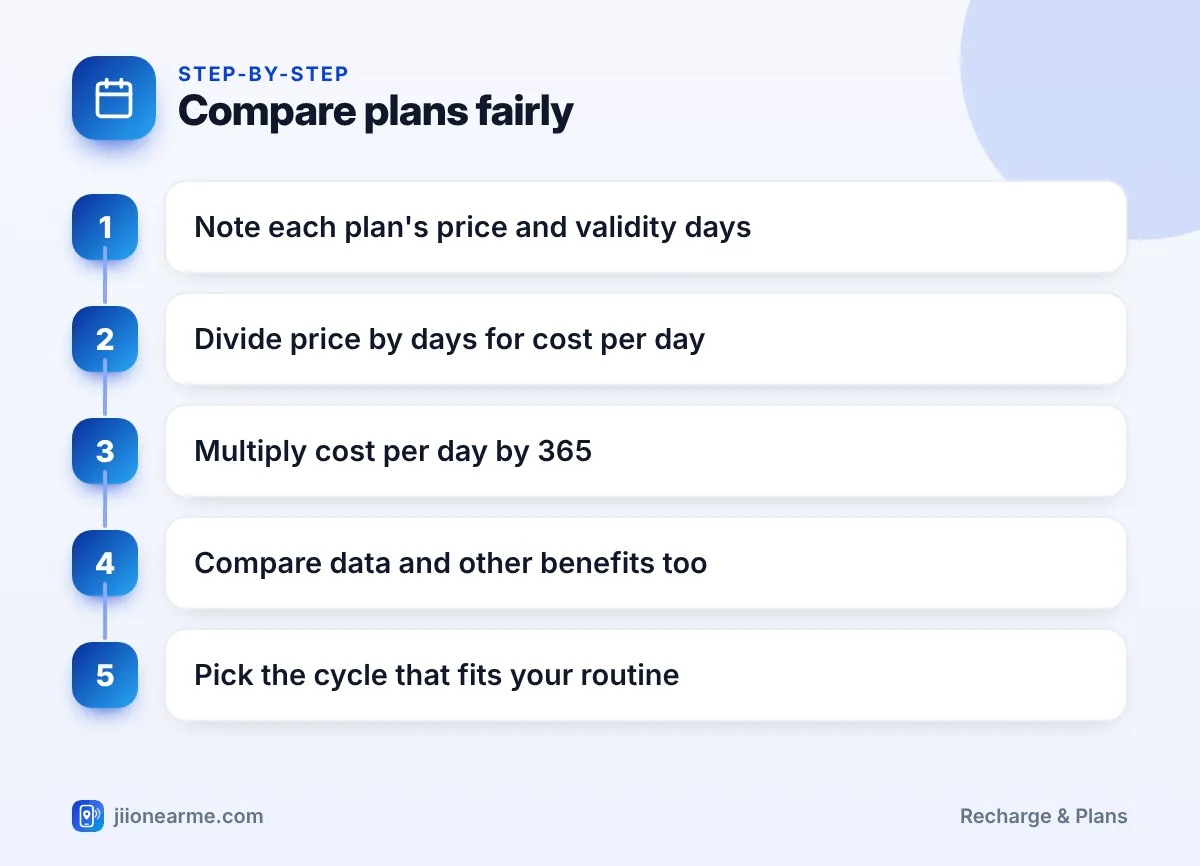
The headline price of a plan does not tell you its real value. A plan with a longer validity may cost more but work out cheaper per day. Use this method to compare any two plans fairly:
- Note the price and the exact validity in days for each plan.
- Divide the price by the number of days to get the cost per day.
- Multiply the cost per day by 365 to see the approximate yearly cost.
- Compare the daily data, SMS and any app benefits, not just the cost.
- Think about convenience, such as a fixed date or fewer recharges.
For a calendar-month plan, divide the price by about 30.4, which is the average length of a month. This gives you a cost per day you can compare fairly with day-based plans.
Which Validity Cycle Suits You
There is no single best option. It depends on how you manage money and how much you use your phone.
- 28-day plans suit people who are fine with frequent recharges and want a wide choice of plans.
- Calendar-month plans suit people who like paying on a fixed date, such as right after salary day.
- 30-day plans suit people who want something close to a month without a fixed date.
- Long-validity plans suit people with steady usage who want fewer recharges and can pay more upfront.
Two plans with similar prices can differ a lot in daily data and validity. Always check the full plan details before paying.
Frequently Asked Questions
Why do I have to recharge Jio 13 times a year?
Most plans last 28 days, and 13 cycles of 28 days cover 364 days. So a full year needs about 13 recharges instead of 12.
Does Jio offer calendar-month validity plans?
Calendar-month options have been offered following TRAI’s direction, but plan lists change. Check MyJio or jio.com for the current options for your number.
Is a 30-day plan the same as a calendar-month plan?
No. A 30-day plan always lasts 30 days, so its due date drifts slightly. A calendar-month plan renews on the same date every month.
How can I tell which plan is cheaper over a year?
Divide each plan’s price by its validity days to get the cost per day, then multiply by 365. The plan with the lower yearly figure is cheaper, before you compare benefits.
Why does my recharge date change every month?
On a 28-day plan, each cycle is shorter than most months, so your due date moves a few days earlier each time. A 4-week repeating reminder keeps you on track.
Wrapping Up
The 28-day cycle is why you recharge 13 times a year, not 12. It is not a trick, just day-based counting. If you prefer a fixed date, look for calendar-month options in MyJio. Whatever you choose, compare plans by cost per day and yearly cost, check the benefits, and set a reminder that matches your plan’s real cycle.
JIo Near me is an independent guide and is not affiliated with Reliance Jio. App menus, plans and policies can change – always confirm current details in the official MyJio app or on jio.com. We will never ask for your OTP, PIN or passwords.