For most people, 5G is clearly better than 4G when downloading or uploading large files, streaming high-quality video or using the network in a crowded place. For messaging, maps and casual browsing, a good 4G connection often feels almost the same. The real gap depends less on the label and more on signal strength, coverage and crowding where you are.
This comparison looks at the five things that matter in daily use: speed, latency, coverage, indoor reach and battery. Each section explains the difference in plain terms and when you will actually notice it on your phone.
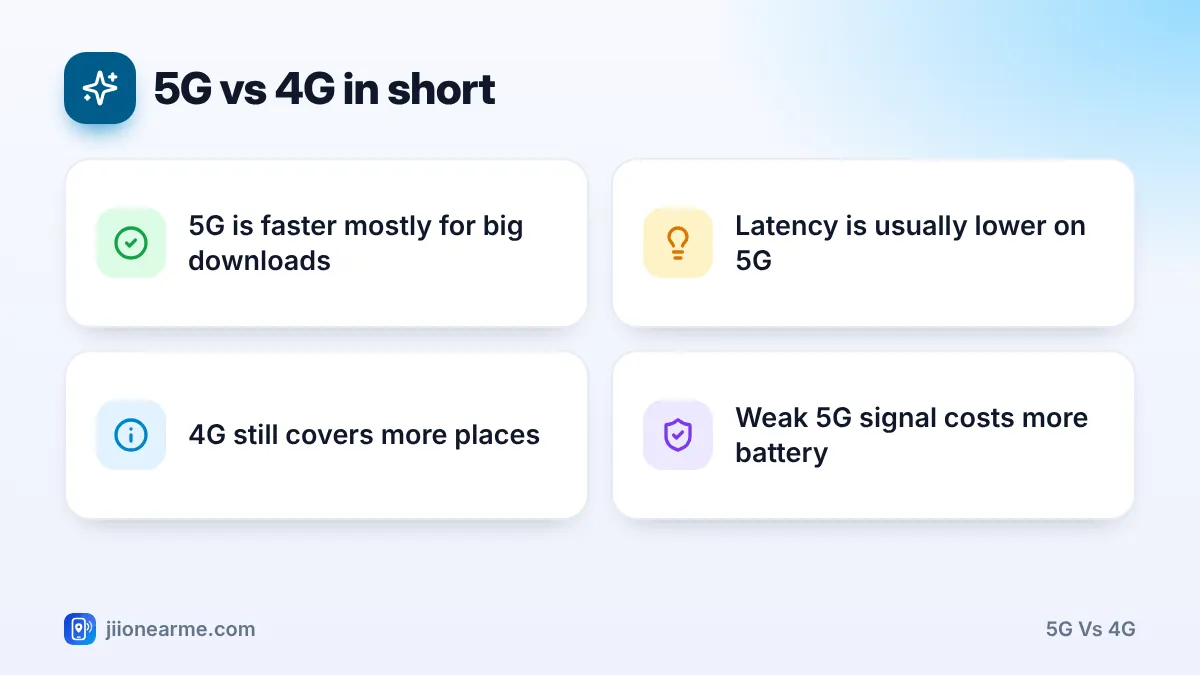
- 5G has much more capacity, so it is usually faster, especially in busy areas and for large downloads.
- Latency (delay) is generally lower on 5G, which helps gaming and video calls a little.
- 4G still covers more places and is very mature, including in many rural areas.
- 5G mid-band signal weakens faster indoors, and weak 5G can use more battery.
Speed: Where 5G Pulls Ahead
5G uses wider blocks of spectrum and newer radio technology. In simple terms, the road is wider, so more data moves at once. That gives two benefits:
- Higher top speed: large app updates, game downloads and file uploads finish faster.
- More capacity: a 5G site can serve many more users before slowing down. That is why 5G often holds up better than 4G in busy markets, stations and offices.
For small tasks, the difference shrinks. A WhatsApp message or a simple web page is so small that 4G already loads it quickly. You notice 5G most with big files and when many people share one tower.
Upload speed
Upload speed matters when you post videos, back up photos to JioAICloud or join video calls. 5G uploads are usually better than 4G uploads in good signal. On both networks, though, uploads are slower than downloads.
Latency: The Delay You Feel in Games and Calls
Latency is the time a small piece of data takes to reach a server and come back. It is measured in milliseconds and shown as “ping” in speed test apps. Lower is better.
5G is designed for lower latency than 4G, and a standalone 5G network like Jio True 5G removes some of the steps that 4G-based 5G needs. In practice, you may see somewhat lower ping on 5G. The distance to the game or app server still matters a lot. A faraway server will feel slow on any network.
If you game online, look at the ping figure in your speed test app and test against a nearby server. A steady, low ping matters more for gaming than a very high download number.
5G vs 4G Coverage and Indoor Reach
Coverage is where 4G still has the edge. 4G networks have been built out for years and reach a very wide area, including many villages and highways. Jio has rolled out 5G across many cities and towns, but coverage still varies street by street and room by room.
When 5G is not available or is too weak, your phone drops to 4G on its own. That is by design, so you stay connected.
Why indoor signal differs
Indoor signal depends heavily on the frequency band:
- Lower bands, such as Jio’s 5G n28 and 4G band 5, travel further and pass through walls better.
- Higher bands, such as Jio’s 5G n78, carry more speed but lose strength through walls, glass and floors.
This is why 5G can look great on the balcony and disappear in an inner room. In some homes, 4G gives the steadier connection indoors, and that is perfectly fine.
Battery Use on 5G and 4G
A 5G modem with good signal is not necessarily a battery hog. The drain people notice usually comes from two situations:
- Weak 5G signal, where the phone raises its transmit power and keeps searching.
- Frequent switching between 5G and 4G at the edge of coverage.
Many phones manage this with smart or auto 5G modes that use 4G when 5G would add little. If your battery drops fast in a weak 5G spot, switching to 4G there can help.
Side-by-Side Comparison
| Factor | 4G | 5G |
|---|---|---|
| Typical speed | Good for most daily use | Higher, especially for big downloads |
| Capacity in crowds | Slows down when busy | Handles crowds better |
| Latency | Low enough for most uses | Generally lower |
| Coverage | Very wide and mature | Growing, varies by area |
| Indoor reach | Good on low bands | Good on n28, weaker on n78 |
| Battery | Steady | Fine in strong signal, higher in weak signal |
| Phone needed | Any 4G VoLTE phone | 5G phone with Jio’s bands and SA support |
Both networks carry calls well. On many phones, a call that starts on 5G moves to 4G VoLTE while you talk, then the phone returns to 5G. So call quality is not a reason to pick one over the other.
How to Compare 5G and 4G on Your Own Phone
The most useful answer comes from your own location. Try this simple test:
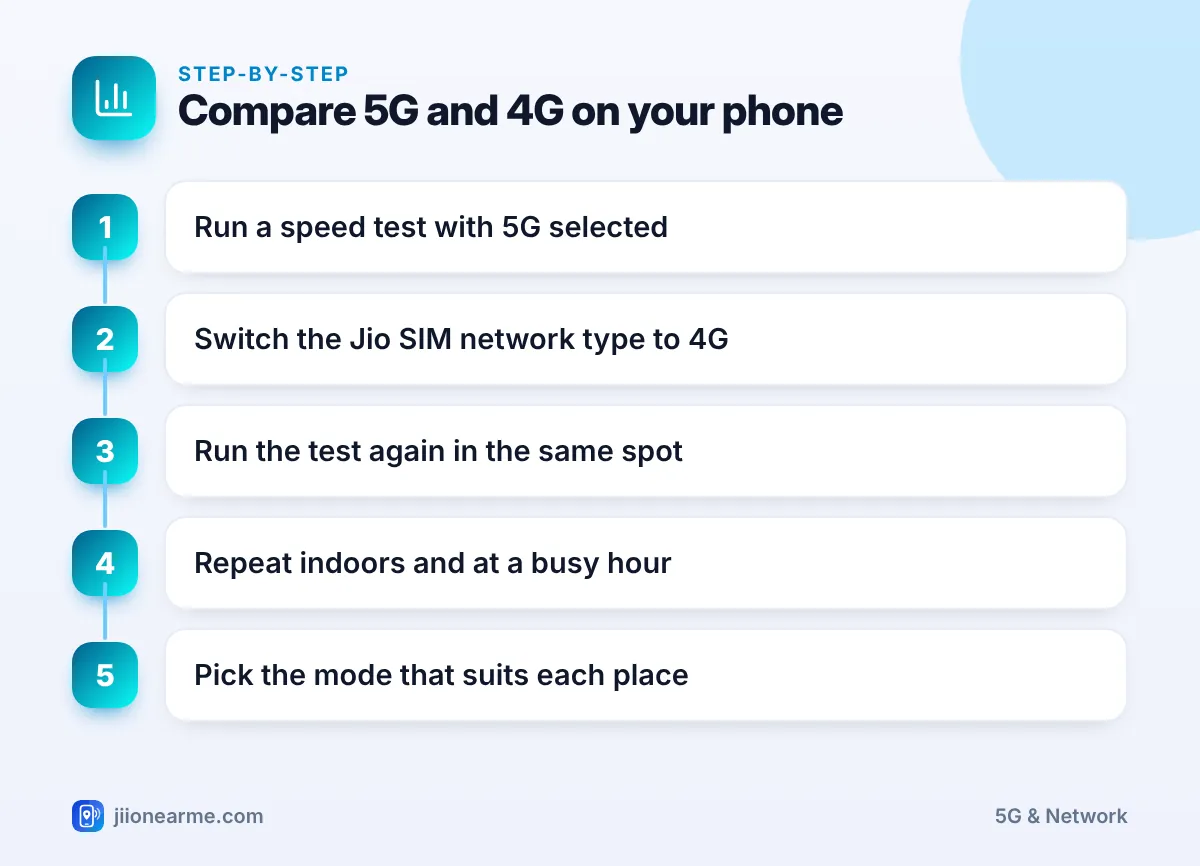
- In a spot where you see the 5G icon, run a speed test and note the download, upload and ping figures.
- Open your SIM settings and change the Jio SIM’s preferred network type to 4G (LTE).
- Run the test again in the same spot.
- Repeat indoors and at a busy hour, such as late evening.
- Switch the network type back to 5G, or keep 4G in places where it works better for you.
A speed test shows a single moment. Crowding, weather and how you hold the phone all affect results, so compare a few readings instead of one.
Whether you can use 5G data, and how much, depends on your plan. Check the current terms in the MyJio app or on jio.com.
Frequently Asked Questions
Is 5G worth it if 4G works fine for me?
If you mostly chat, browse and use maps, 4G may feel good enough. 5G helps most with large downloads, high-quality streaming and busy places where 4G slows down.
Why is my 4G sometimes faster than my 5G?
You may be on a weak 5G signal, a crowded 5G site or indoors far from the tower. A strong 4G signal can beat a weak 5G one.
Does 5G use more data than 4G?
The same file uses the same data on both. But apps often raise video quality on faster connections, so your usage can rise. Set video quality limits in your apps if your plan has a daily limit.
Do I need a new SIM for 5G?
No. Your Jio 4G SIM works on Jio 5G. You need a compatible 5G phone and coverage in your area.
Final Thoughts
5G is a real upgrade in speed, capacity and latency, but 4G remains a dependable network with wider reach. Keep 5G on where the signal is good, and do not worry when your phone drops to 4G indoors or in remote areas. If 5G performs poorly at a spot you use every day, test both modes there and choose what works best.
JIo Near me is an independent guide and is not affiliated with Reliance Jio. App menus, plans and policies can change – always confirm current details in the official MyJio app or on jio.com. We will never ask for your OTP, PIN or passwords.
