Neither option is better for everyone. A physical SIM is simpler if you change phones often or use basic devices, while an eSIM is better for dual SIM on a single-tray phone, frequent travel and protection against SIM theft. Your Jio number, plan and network quality are the same either way.
The right choice depends on how you use your phone. This comparison looks at convenience, changing phones, running two numbers, travel and what happens if your phone is lost or stolen, so you can decide in a few minutes.
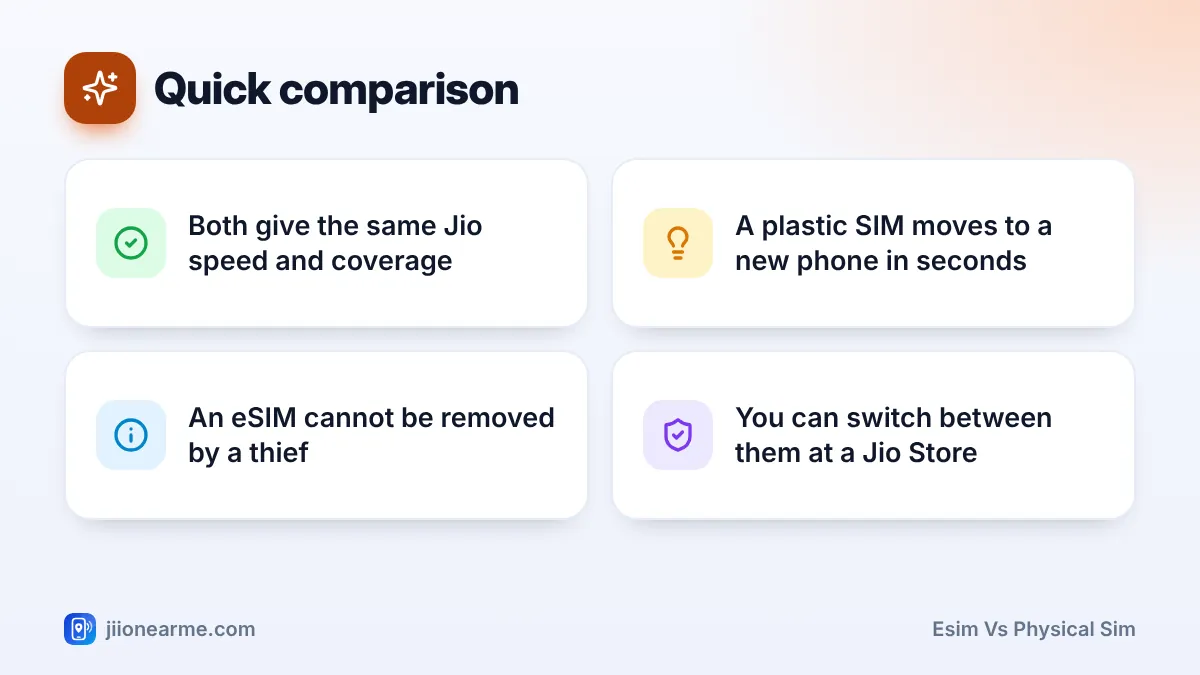
- eSIM and physical SIM give the same Jio speeds, coverage and plans.
- A physical SIM is easier to move between phones.
- An eSIM frees the SIM tray for a second number.
- An eSIM cannot be pulled out and misused by a thief.
- You can switch from one type to the other later.
eSIM vs Physical SIM: Quick Comparison
Here is how the two compare on the points that matter most to Jio users.
| Point | Physical SIM | eSIM |
|---|---|---|
| Phone support | Almost every phone, including feature phones | Only eSIM-capable phones |
| First setup | Insert the card and restart | Request by SMS or at a store, then download |
| Changing phones | Move the card yourself | Request a new eSIM for the new phone |
| Dual SIM | Needs two trays or a tray plus eSIM | Leaves the tray free for another SIM |
| Travel | Swap in a local SIM, store Jio card safely | Add another line while keeping Jio installed |
| Phone stolen | Thief can remove and use the SIM | Thief cannot remove the eSIM |
| Physical damage | Card or tray can wear or get lost | Nothing to lose or damage |
Convenience and Everyday Setup
A physical SIM is hard to beat for simplicity. You get a card, insert it, wait for activation and start using it. If something goes wrong, a store can see and replace the card.
An eSIM takes a little more effort at the start. You need your phone’s EID and IMEI, a request by SMS or a store visit, a confirmation step and a Wi-Fi connection to download the profile. Once it is set up, though, there is nothing more to manage. No card can fall out, and there is no tray to open during a repair.
Changing Phones
This is where the two differ most. With a physical SIM, you move the card from the old phone to the new one. The whole job takes less than a minute.
With an eSIM, the profile belongs to one phone’s chip. To move your Jio number, you request a new eSIM for the new phone’s EID, confirm the change and download it. Some phones offer built-in transfer tools, but these work only where the operator supports them. Either way, it takes longer than moving a card.
If you upgrade phones every year, or often pass your SIM between handsets at home, a physical SIM will save you time. If you keep a phone for several years, the eSIM setup effort is a one-time job.
Running Two Numbers on One Phone
Many phones have a single SIM tray but also support an eSIM. In that case, putting your Jio number on the eSIM lets you keep a second physical SIM, such as an office number, in the tray.
On phones with two trays, an eSIM gives no extra advantage for dual SIM. On most phones, both lines stay on standby for calls and SMS, while you choose one for mobile data.
Travelling Abroad
If you use Jio international roaming, both SIM types work the same way. The difference shows when you buy a local SIM or a travel eSIM abroad.
- With a physical Jio SIM, you may need to remove it to fit a local card, which means keeping a tiny card safe throughout the trip.
- With a Jio eSIM, many phones let you add a travel line and keep Jio installed. You can turn the Jio line off or on as needed.
If Your Phone Is Lost or Stolen
With a physical SIM, a thief can take out your card and put it into another phone, then try to receive OTPs for your bank or UPI. A SIM PIN helps, but many people never set one. An eSIM cannot be removed, so this risk is lower, though you should still block the line quickly.
Whatever the SIM type, act fast:
- Block the SIM by calling Jio’s toll-free number 1800-889-9999 from another phone.
- File a police complaint and keep a copy.
- Block the phone’s IMEI using the lost or stolen phone option on Sanchar Saathi.
- Get a replacement at a Jio Store with your original ID. You can choose a physical SIM or an eSIM for your new phone.
- Change passwords for your email, bank and UPI apps.
Whichever SIM you use, never share an OTP with anyone who calls about a SIM change, eSIM request or blocked number. Jio’s confirmation messages are meant for you alone.
How to Decide: A Simple Checklist
Ask yourself these questions in order:
- Does your phone support eSIM? If not, the choice is made. Stay with a physical SIM.
- How often do you change phones? Often means physical. Rarely means either works.
- Do you need two numbers on a single-tray phone? If yes, the eSIM is the clear winner.
- Do you travel abroad regularly? An eSIM makes adding a travel line easier on many phones.
- How much does theft worry you? An eSIM removes the risk of someone pulling out your SIM.

If most of your answers point one way, go with that. If it is a tie, a physical SIM is the more flexible starting point, and you can convert to an eSIM later by SMS or at a Jio Store.
JioPhone, JioBharat, JioFi and most routers or dongles take a physical SIM. If your Jio number may need to move into one of these, keep it on a plastic card.
Frequently Asked Questions
Is an eSIM safer than a physical SIM?
An eSIM is safer against physical theft because it cannot be removed. Both types can still be targeted by SIM swap scams, so never approve a SIM change you did not request.
Does an eSIM give better 5G or signal?
No. Jio True 5G, 4G and signal quality depend on the network where you are and your phone, not on the SIM type.
Can I have both an eSIM and a physical SIM?
Yes, on phones that support it. Many people keep Jio on the eSIM and a second number on the physical SIM, or the other way round.
Can I switch from eSIM back to a physical SIM?
Yes. Visit a Jio Store with your original ID proof and ask for a physical SIM. The eSIM stops working once the new card is active.
Which is better for elderly parents?
A physical SIM is often easier for them, since a store or family member can move it to a new phone without SMS formats or QR codes.
Conclusion
The eSIM vs physical SIM choice comes down to habits, not network quality. Pick a physical SIM if you change phones often or use basic devices, and an eSIM if you want dual SIM on a single-tray phone, travel often or want stronger protection from SIM theft.
Neither decision is permanent. You can move between the two later, so choose what suits your phone use today.
JIo Near me is an independent guide and is not affiliated with Reliance Jio. App menus, plans and policies can change – always confirm current details in the official MyJio app or on jio.com. We will never ask for your OTP, PIN or passwords.