
In times when we live in the digital world where digital communication prevails in our everyday life, text messages played an important role in personal and business communication. Yet, when legal issues are involved, such as a court battle, an investigation, a dispute, questions tend to come up regarding the duration of retention of such messages by companies, such as Verizon, as well as when they will be obtained through a subpoena. This paper will explore what Verizon does in terms of text message retention, how they process the legal requests, as well as the specifics of the privacy policy. We will discuss the differences between message content and metadata, the way it is done in the courts of law, and what this entails to the end user and the police. Everyone who has to maneuver the privacy issues or even a court case in 2025 needs to understand these aspects.
Understanding Text Message Retention: Content vs. Metadata
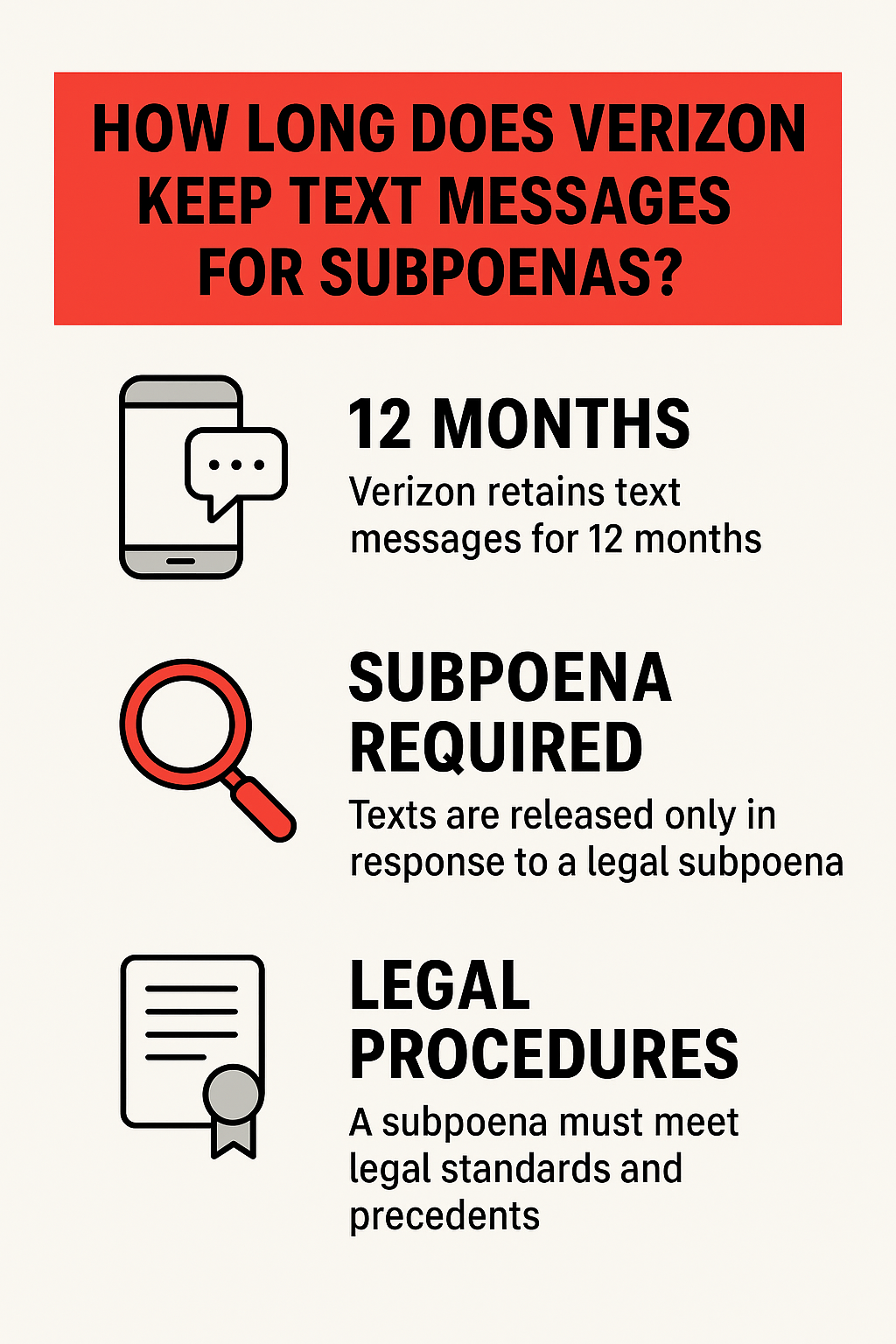
In order to provide the answer to the main question-how long does Verizon retain text messages in the case of subpoena- it is worth distinguishing between the actual content of the text messages and the metadata of the latter. Text message content entails words, images, or files that are shared in the discussion. Metadata, however, contains information such as the date and time of messaging, the phone numbers of the people who sent the message (the sender and receiver) and in some cases the duration of message or type.
Verizon holds the contents of text messages very briefly according to the claims of the various sources, such as the legal experts and the Verizon community forums. This is normally between 3 and 10 days. As an example, there is evidence that Verizon only retains text content 3-5 days in their servers before they are deleted. This short retention is meant to assist in delivery and simple troubleshooting but not storage. After such window, the material cannot be reinstated and can not be retrieved in any way by Verizon, even under subpoena. A newer estimate of 2025 indicates that messages are stored in files up to 10 days or 240 hours. Such difference may be based on the nature of messaging service, including regular SMS and sophisticated messaging.
Metadata on the other hand lasts a lot longer. Verizon usually retains the information about text messages within a period of one year. This contains data on the date and recipient of a message sent, but not the content or media supplied. In certain message histories, some older sources give 90 days, although, as as of today, the current practices follow more closely a one-year time span on the basis of billing and legal matters. Federal laws demand that carriers keep a set of records at least six months, yet in practice Verizon keeps them at least a year in most instances, both in terms of call and text records.
What is the reason behind such low retention on content? Telecom companies such as Verizon process billions of messages every day and storage of such information on an indefinite basis would consume vast resources and be a great issue of privacy issues. Minimal retention time assists in reducing data breaches and adherence to privacy regulation. In the case of subpoenas, it implies that when a law enforcement or a court requests text content, they have to do it within the next 3-10 days or it will not be provided by Verizon. Metadata is less sensitive and is stored for a longer duration in order to help resolve billing disputes, network analysis, and legal inquiries.
Verizon’s Methods for Handling Subpoenas and Legal Requests
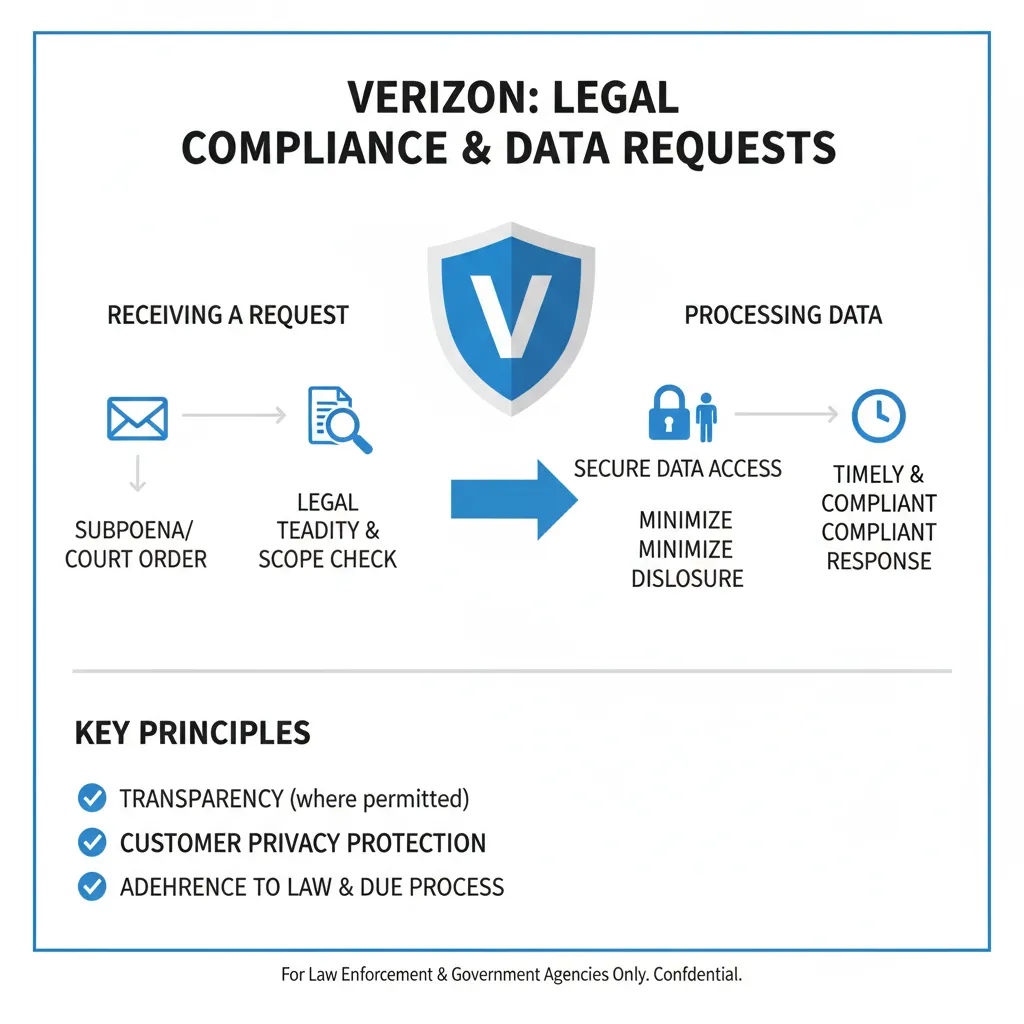
Verizon has rigid procedures that the federal laws, such as Stored Communications Act (18 U.S.C. 2701 et seq.), and its transparency policies dictate regarding subpoenas. Subpoena refers to a document of law that forces a company to give information or testify. In the case of Verizon, courts, prosecutors, criminal or civil investigators may issue subpoenas.
The first half year of 2025 Transparency Report released by Verizon sheds some light on the processing of these requests. During the time, Verizon was served with 84,813 subpoenas, and more than 154,943 customer accounts were involved. Such subpoenas usually seek the most basic subscriber data, including names, addresses, phone numbers, and call or text records (metadata). Notably, the text of messages is not communicated content-like text of messages that Verizon renders in response to a standard subpoena. To grant content, the law must achieve a greater burden, typically, a probable cause search warrant.
Also check our new article on Will verizon accept third party doxo?
The process works in that once a legal demand is received by Verizon it starts. Their legal department evaluates it on its legality, and it should not go against the law. They retrieve the requested information on their systems, provided that they are valid. In the case of text messages, when the subpoea requests information on the metadata of the messages that were sent within the last one year of retention, Verizon will be able to give such information as timestamps and the sending and receiving numbers. But when it comes to content and when the messages are more than 10 days, the response can be as simple as it has no records as a result of retention restrictions. As a matter of fact, approximately 10 percent of all the demand in the year 2025 was either rejected or not fulfilled, most of the time due to the fact that the data had surpassed the retention periods or that the request was invalid.
For more sensitive data, Verizon requires escalated legal processes:
- Court Orders: Under 18 U.S.C. § 2703(d), these can access transactional data beyond basic subscriber info, but still no content.
- Search Warrants: Needed for stored content, including text messages. In the first half of 2025, Verizon handled 29,721 warrants, with 13,831 specifically for stored content. Warrants require a judge’s approval based on probable cause that the data evidences a crime.
- Wiretap Orders: For real-time interception of content, but these are rare (only 314 in 1H 2025) and not typically for stored texts.
- Emergency Requests: In urgent situations, like threats to life, Verizon can provide data without a warrant, including location or messages if available.
National security requests, including National Security Letters (NSLs) by the FBI (0-499 in 1H 2025) or foreign intelligence surveillance act (FISA) orders are also processed by Verizon, but are not disclosed individually due to security reasons and are usually not related to daily text messages. In each instance, Verizon will charge a fee to respond to some responses (e.g., wiretaps) although not the majority of subpoenas. They inform the customers about requests when they are legally allowed by providing them with an opportunity to contest the disclosure.
Such technologies guarantee the absence of complacency and user privacy. Lawyers or investigators will have to identify precisely what they want-content or metadata-and schedule their subpoenas accordingly. Slowness may imply loss of data, since Verizon systems automatically delete the old records.
Verizon’s Privacy Policy: A Closer Look
Verizon have an updated privacy policy that they have on their site which stresses on the importance of transparency and control of the data to the user. The policy addresses the way Verizon gathers, processes, disseminates, and stores personal data, such as communications such as text messengers.
Verizon gathers information on service use, such as text and messaging history to deliver and enhance services, avert fraud, and adhere to the law as per the policy. Data on the individual is only stored until it is needed in the business, legal, tax, audit, investigation, or security. Although the specific timelines of text messages are not mentioned, the policy is consistent with the industry: short-lived content and the long-lived metadata. Indicatively, in the Cable Act (to which certain Verizon services are subjected), personally identifiable information is retained as far as reasonably necessary.
On the aspect of sharing, Verizon only shares information with third parties or governmental authorities where a law necessitates it, e.g. in response to a subpoena or a warrant. They do not sell personal information, but can submit de-identified data to analytics. There are options available to customers: they can refuse some marketing applications, view their data, or get them deleted. State laws (such as California Consumer Privacy Act) provide additional protection to sensitive data, such as text content, and demand consent or legal justification to disclose them.
The policy also brings out precautions against unauthorized access such as encryption and secure storage. In case of a breach, users are notified by Verizon. In the case of legal requests, the policy refers to the Transparency Report, which states the aggregate information about government demands without exposing single cases. This privacy policy makes trust, and users must save essential texts, as Verizon is not a long-term storage.
Implications and Alternatives for Accessing Old Text Messages
The short retention periods have significant implications for subpoenas. In legal cases, such as divorce proceedings or criminal investigations, parties often seek text messages as evidence. If a subpoena arrives after 10 days, content is unavailable from Verizon, forcing reliance on device backups or the other party’s records. Metadata can still provide context, like proving communication occurred, but not what was said.
Alternatives include:
- Device Backups: iPhones and Androids store messages locally or in the cloud (e.g., iCloud, Google Drive). Subpoenas can target these instead.
- Third-Party Apps: Services like WhatsApp or Signal retain messages on user devices, not carrier servers.
- Forensic Recovery: Experts can sometimes recover deleted messages from phones, but this requires physical access and court approval.
- Self-Preservation: Users can screenshot or export messages via Verizon’s app for up to 90 days of history.
Law enforcement pushes for longer retention, but privacy advocates argue against it, citing risks of mass surveillance.
Conclusion
To conclude, a subpoena is essential to getting complete records as Verizon retains text message contents between 3 and 10 days and metadata no later than a year. Their approaches include strict scrutiny of law requirements, as outlined in the 2025 Transparency Report so that only relevant data is revealed-metadata through subpoenas and content through warrants. This is supported by the privacy policy, which focuses on limited retention and user privileges by placing the requirements of the service against excessive protection.
In case it concerns a subpoena or any privacy issue, it is better to consult legal specialists and refer directly to the current Verizon policies. Awareness of these boundaries in the interconnected world will enable users to make decisions about their online imprints that are respectable. It is important to remember that though a carrier such as Verizon delivers the much needed services in your life, it is up to you to have the last word regarding the kind of messages you send.
