Your Jio number has not won a lottery. Messages and calls claiming that a “Jio lucky draw” or “SIM card lottery” picked your number are a long-running fraud, and the aim is to make you pay a “processing fee” for a prize that does not exist.
Here is how the Jio lottery scam usually works, the warning signs that give it away, and how to block and report the sender without putting your money or personal details at risk.
- You cannot win a lottery or draw you never entered, no matter what the message says.
- The scam always ends with a fee: processing, tax, GST, transfer or “RBI clearance” charges.
- Messages often use logos, celebrity photos, fake certificates and international numbers.
- Never pay, share bank details or send ID documents to claim a prize.
- Report the chat in WhatsApp, report the number through Chakshu, and call 1930 if you paid.
What a Jio Lottery Message Looks Like
The wording changes, but the content is familiar. You might see:
- “Congratulations! Your Jio number has won a cash prize in our lucky draw.”
- A picture of a winner’s certificate or cheque with your number written on it.
- A Jio logo, a TV quiz show logo or a famous film star’s photo.
- A “lottery number” and an instruction to contact a “manager” on WhatsApp.
- A voice note or call from someone claiming to be a bank officer handling your prize.
Many of these come from numbers with foreign country codes, though some use Indian numbers. The display picture and profile name are chosen to look official.
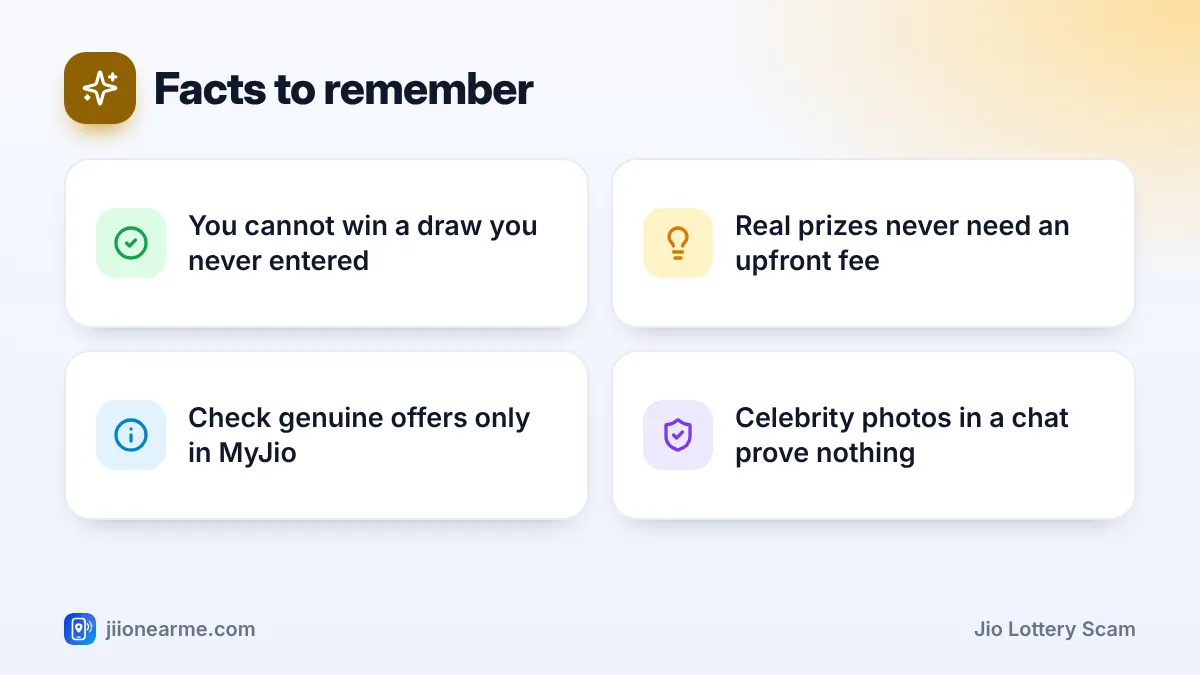
Anyone can copy a logo, a celebrity photo or a bank seal. An official-looking image in a WhatsApp chat does not make a message genuine.
How the Jio Lottery Scam Works
The trick follows a set pattern designed to keep you hooked.
- The prize announcement. You are told you have won a large cash prize, a car or a phone in a draw linked to your SIM.
- The “verification” step. You are asked for your name, address and age, and sometimes Aadhaar or bank details, to “process” the prize.
- The first fee. A “processing fee” or “registration charge” must be paid before the prize is released. It looks small compared to the prize.
- The fee ladder. After the first payment, new charges appear: income tax, GST, transfer fee, customs or an “RBI clearance”. Each time, you are told this is the final step.
- Pressure and threats. If you hesitate, they say the prize will be cancelled, or even threaten legal action for “wasting the company’s time”.
- The vanishing act. Once you stop paying, the number goes silent or blocks you.
The whole idea rests on one feeling: you have already paid something, so you pay more to avoid losing it. Fraudsters count on this.
Why These Prize Messages Are Always Fake
A few simple facts expose the scam.
- You did not enter any draw. Simply having a mobile number does not enter you into a lottery.
- Real prizes do not need upfront fees. Any tax on a genuine prize is handled through proper legal processes, not by sending money to a stranger’s UPI ID.
- Prize schemes are regulated. Random cash giveaways to SIM numbers announced through WhatsApp are not how legal prize schemes work.
- Official offers appear in official places. Genuine Jio offers and promotions are shown in the MyJio app or on jio.com, not in chats from unknown numbers.
| What the scammer says | The reality |
|---|---|
| “Your SIM number won a lucky draw” | You cannot win a draw you never entered |
| “Pay a small fee to release the prize” | Genuine prizes do not need advance payments |
| “Pay tax first, then get the prize” | Tax is not collected through personal UPI IDs |
| “Talk only to our manager on WhatsApp” | Real companies use official support channels |
| “Send Aadhaar and bank passbook” | These can be misused for other frauds |
How to Report and Block the Sender
If you receive a lottery or lucky draw message, follow these steps.
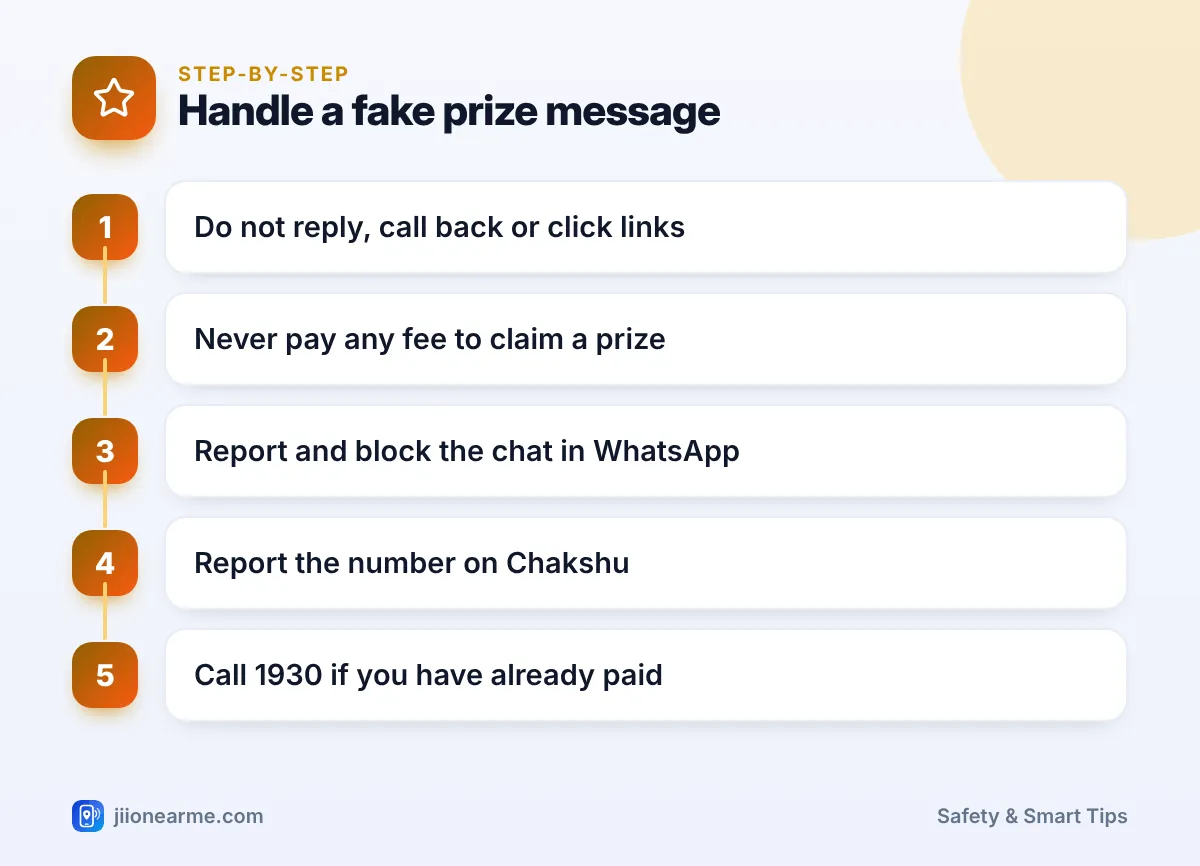
- Do not reply or engage. Even a reply like “who is this?” tells the scammer your number is active.
- Do not click links or open files. Links can lead to fake forms, and files can be harmful apps.
- Report the chat in WhatsApp. Open the chat, tap the contact name at the top and choose Report. You can block the contact at the same time. Labels may differ slightly by app version.
- Report through Chakshu. Use the Chakshu facility on the Sanchar Saathi portal or app to report the number and message. Keep a screenshot ready.
- Delete the message. Once reported, delete it so no one else in the family acts on it by mistake.
- Warn your family. Older relatives are often targeted because they tend to trust official-looking messages.
In WhatsApp privacy settings, limit who can add you to groups, and turn on the option to silence calls from unknown numbers if your app version offers it. This cuts down a lot of scam traffic.
What to Do If You Already Paid or Shared Details
If you paid any fee, move fast.
- Call the national cybercrime helpline 1930 immediately.
- File a complaint on cybercrime.gov.in with screenshots, phone numbers, UPI IDs and transaction references.
- Call your bank’s official helpline and ask about blocking or disputing the payment.
- If you shared Aadhaar, PAN or bank details, stay alert to loan apps, new SIMs or accounts opened in your name. You can check mobile connections issued in your name on the Sanchar Saathi portal.
- Do not pay anyone who offers to recover the lost money for a fee.
Many people do not report because they feel embarrassed. These gangs target thousands of people with a well-practised script. Reporting quickly is the best thing you can do for yourself and for others.
Frequently Asked Questions
Does Jio run a lottery or lucky draw on mobile numbers?
Do not trust any lottery claim that arrives by WhatsApp, SMS or a call from an unknown number. Check genuine offers only in the MyJio app or on jio.com, and call 199 from your Jio number if in doubt.
Why do scammers ask for a processing fee?
The fee is the scam itself. There is no prize, so every payment you make simply goes to the fraudster.
The message came from an international number. Can it be genuine?
That is a strong warning sign. A genuine company would not announce a prize through a random international WhatsApp number.
I only replied to the message. Am I at risk?
If you did not pay or share any details, the risk is low. Block and report the number, and ignore any further calls or messages from them.
Where should I report a Jio lottery scam?
Report the number through Chakshu on the Sanchar Saathi portal or app, and report the chat in WhatsApp. If you lost money, call 1930 or use cybercrime.gov.in.
Conclusion
The Jio lottery scam works because a big prize feels exciting and the fee feels small. Remember the simple truth: no draw, no prize, no fee. Block and report the sender, warn your family, and keep your money and documents away from anyone who promises winnings you never applied for.
JIo Near me is an independent guide and is not affiliated with Reliance Jio. App menus, plans and policies can change – always confirm current details in the official MyJio app or on jio.com. We will never ask for your OTP, PIN or passwords.