Jio plan listings pack a lot of meaning into a few short labels. Words like validity, FUP, add-on and base plan decide what you actually get, how long it lasts and what happens when your data runs out.
This glossary explains each common term in plain language, grouped by topic. Use it alongside the plan details in the MyJio app or on jio.com, because exact benefits and wording can change from plan to plan.
- The base plan keeps your number active. Add-ons only add extra benefits on top of it.
- Validity is how long a plan’s benefits last, counted from when the plan becomes active.
- FUP is the daily or total high-speed data limit, after which speed drops.
- ISD and international roaming are separate from your regular plan and need their own packs.
How to Read a Jio Plan Card
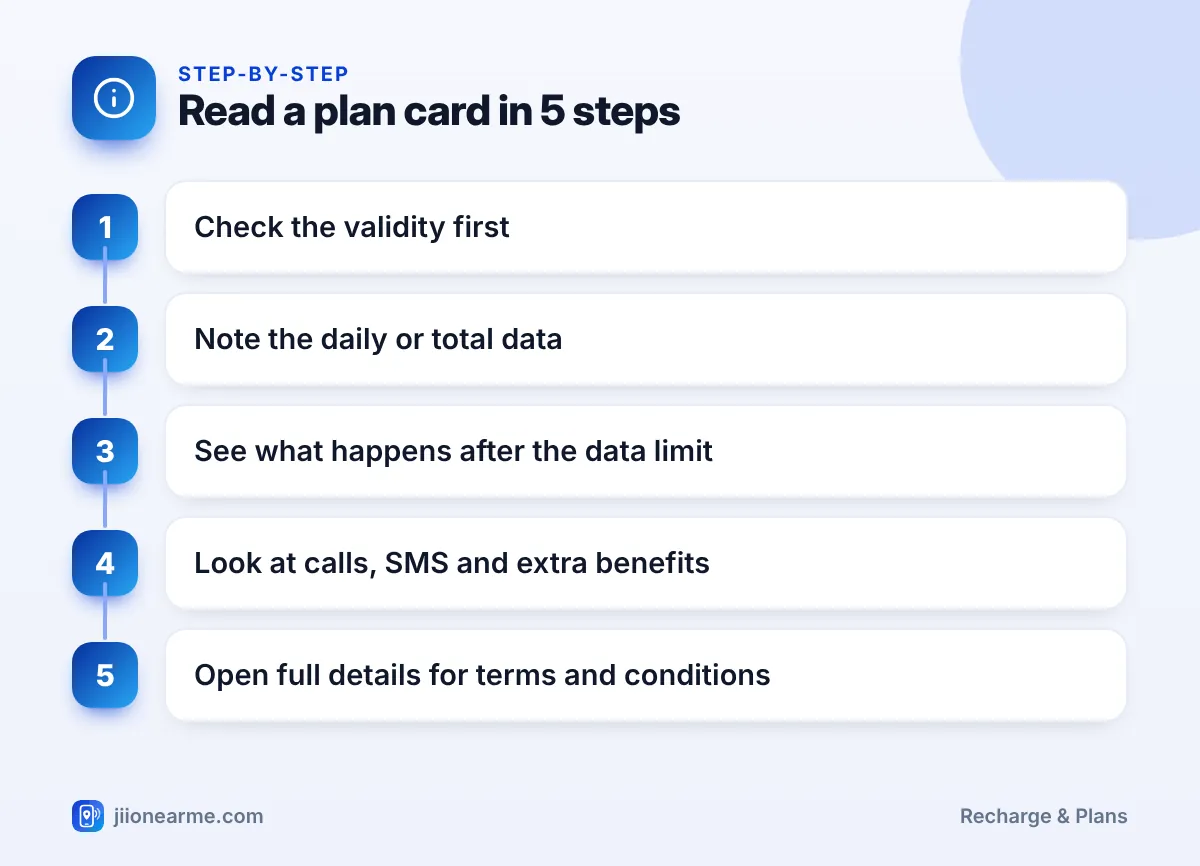
Before the glossary, here is a quick routine for reading any plan card:
- Check the validity. This tells you how long the plan lasts.
- Note the data. See whether it is a daily limit or a total amount for the whole validity.
- Read what happens after the limit. The plan details explain the reduced speed after high-speed data runs out.
- Look at calls, SMS and extras. Extras can include streaming subscriptions, cloud storage or unlimited 5G.
- Open the full details. Tap the plan to read the terms and conditions before paying.
Jio Plan Terms Meaning: Core Plan Basics
Base plan
The base plan is your main prepaid plan. It gives your number its service validity, along with calls, SMS and data. Without an active base plan, most add-ons cannot be used, and outgoing services stop.
Validity
Validity is the number of days the plan’s benefits last, starting from when the plan becomes active. Many monthly plans run for a fixed number of days rather than a full calendar month, so your recharge date can move earlier each month.
Daily data and total data
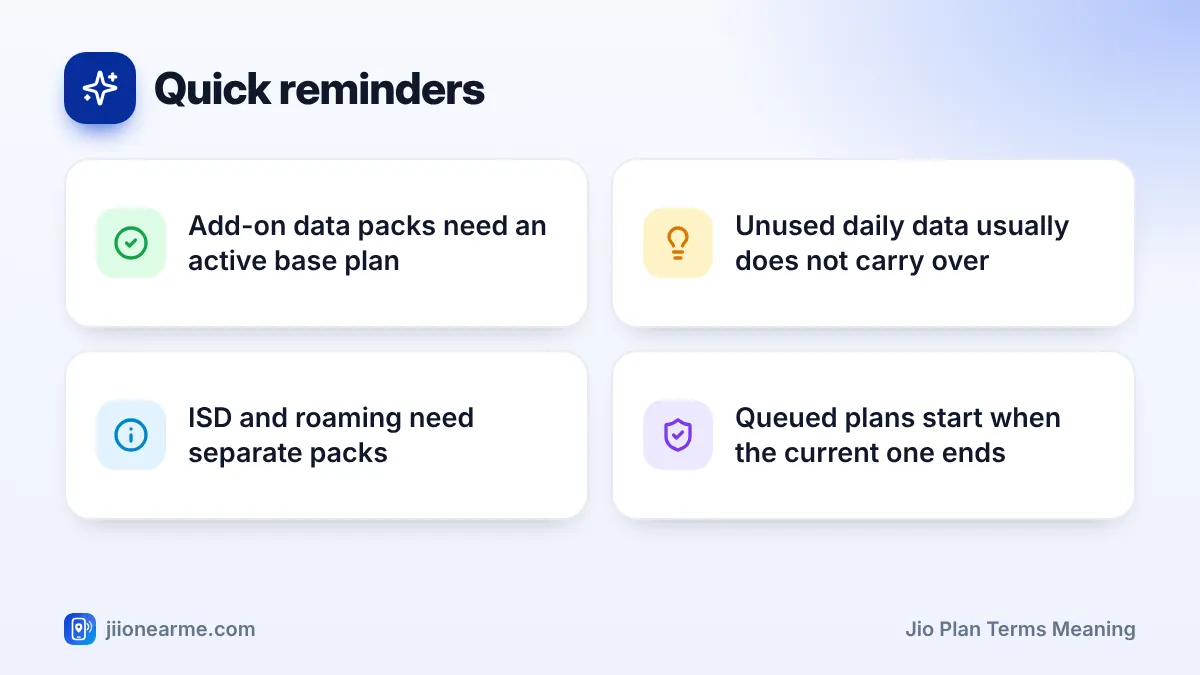
Some plans give a daily data limit that refreshes every day. Others give a total data amount for the whole validity, which you can use at any pace. Daily data that you do not use is generally not carried forward to the next day.
FUP (Fair Usage Policy)
FUP is the limit on high-speed data, or a fair-use condition on unlimited benefits. On plans with daily data, the FUP is the daily high-speed amount. Once you cross it, data does not stop completely. It continues at a much lower speed.
Post-FUP speed
This is the reduced speed after your high-speed data is used up. Jio plan details often list it as 64 Kbps, which is enough for basic messaging but too slow for video. Check the plan details for the exact figure.
Unlimited voice
Unlimited voice means calls to any network within India are included without a minute count. It is still subject to fair usage terms meant to prevent commercial misuse.
SMS per day
Plans often include a daily SMS allowance. After it is used up, further SMS may be charged or blocked for the day, as stated in the plan terms.
Add-Ons, Top-Ups and Advance Recharges
Add-on or data pack
An add-on, also called a data pack or booster, gives extra data on top of your base plan. It usually needs an active base plan and does not extend your number’s validity. It is useful on days when your regular data runs out early.
Top-up
A top-up adds talk time balance to your account rather than a bundle of benefits. It can be used for services charged from balance, such as some ISD calls. Not every plan listing includes a top-up section.
Advance or queued recharge
If you recharge while a plan is still active, the new plan is usually queued. It starts automatically when the current plan ends. Your MyJio app shows queued plans under your plan details.
Before recharging early, check MyJio to see whether the new plan will be queued or will replace the current one. The confirmation screen normally shows when the new plan will start.
International Terms: ISD and International Roaming
ISD
ISD (International Subscriber Dialling) means calling a number in another country from India. Regular plans do not cover these calls. You need an ISD pack for the country you are calling, or you pay ISD rates.
International roaming (IR)
International roaming lets you use your Jio number while you are in another country. Your domestic plan benefits are meant for use in India, so you need an international roaming pack for calls, SMS and data abroad.
ISD is for calling abroad while you are in India. International roaming is for using your phone while you are abroad. Each has its own section on the recharge page.
Extras and Labels You May See
- Unlimited 5G or True 5G: the plan includes unlimited data while you are connected to Jio True 5G, subject to fair usage terms and a compatible phone.
- Complimentary subscription: a streaming or app subscription, such as JioHotstar, included with the plan for a period stated in its details.
- JioAICloud: cloud storage that some plans include for backing up photos and files.
- Annual plan: a long-validity plan that covers most of the year in one recharge.
- JioPhone and JioBharat plans: plans made only for those devices. They do not work on other phones.
Quick Reference Table
| Term | What it means in one line |
|---|---|
| Base plan | Main plan that keeps your number active |
| Validity | How many days the benefits last |
| FUP | Limit on high-speed data or fair use |
| Add-on | Extra data on top of the base plan |
| Top-up | Talk time balance, not a full plan |
| ISD | Calling other countries from India |
| IR | Using your number while abroad |
Frequently Asked Questions
What does FUP mean on a Jio plan?
FUP stands for Fair Usage Policy. On most data plans, it is the daily or total high-speed data limit, after which speed drops for the rest of the day or validity.
Does a data add-on increase my validity?
No. A data add-on gives extra data but does not extend your service validity. You still need an active base plan.
What is the difference between validity and daily data?
Validity is how many days the plan lasts. Daily data is how much high-speed data you get each day within that validity.
Is ISD included in normal Jio plans?
No. Regular plans cover calls within India. For international calls, you need an ISD pack or must pay ISD rates.
Where can I read the full terms of a plan?
Tap the plan card in the MyJio app or on jio.com to open its details and terms before you recharge.
Summary
Most confusion with prepaid plans comes from a handful of terms. Once you know that the base plan sets validity, FUP caps high-speed data and add-ons only top up benefits, plan listings become much easier to compare.
Read the validity and data first, then the post-FUP speed and extras. When in doubt, open the plan details in MyJio before you pay.
JIo Near me is an independent guide and is not affiliated with Reliance Jio. App menus, plans and policies can change – always confirm current details in the official MyJio app or on jio.com. We will never ask for your OTP, PIN or passwords.