If you want one bill and no more tracking of recharge dates, a JioPlus family plan usually suits you better. If each person prefers to pay for themselves and keep spending fixed in advance, separate prepaid numbers are often the simpler choice.
Neither option is better for everyone. The right pick depends on who pays, how much control you want, and how comfortable you are with a monthly bill. This comparison looks at convenience, control, deposits and budgeting, without quoting prices, so you can decide what fits your household.
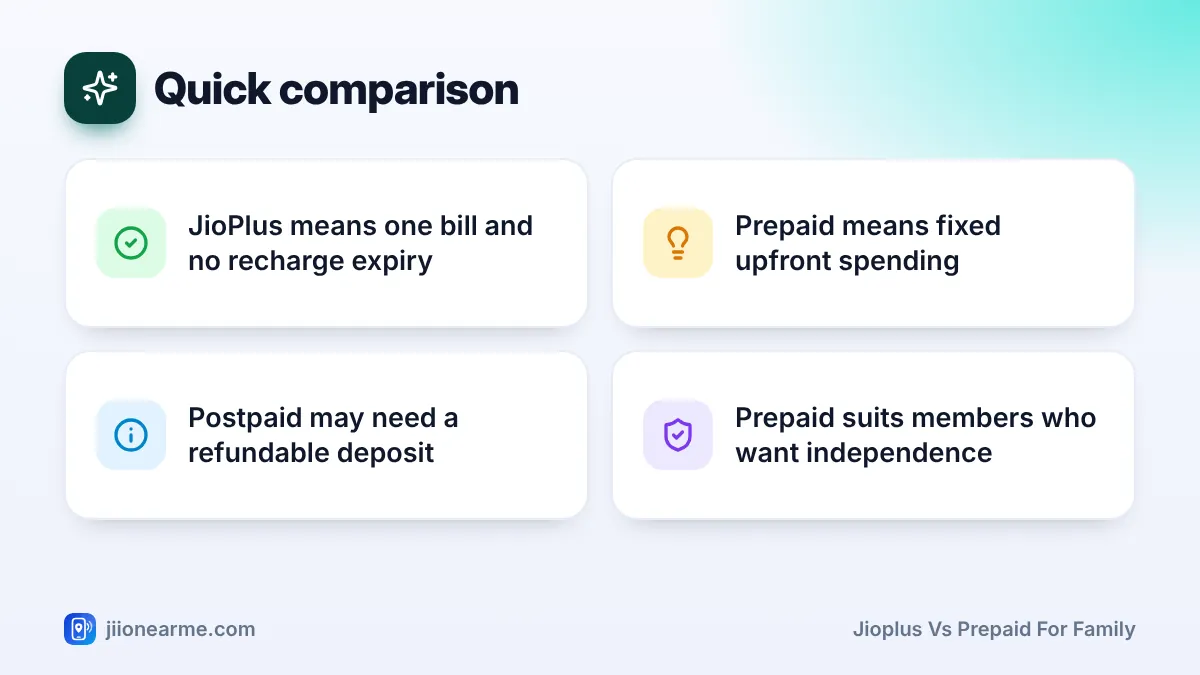
- A JioPlus family plan puts everyone on one postpaid bill paid by the primary holder.
- Separate prepaid numbers mean each person recharges and controls their own spending.
- Postpaid can avoid service breaks from forgotten recharges, but may need a deposit.
- Prepaid gives fixed, upfront spending with no surprise bills.
- Compare current plans in MyJio or on jio.com using your family’s real usage.
How Each Option Works
JioPlus family plan
JioPlus is Jio’s postpaid service. On a family plan, one person holds the primary connection and a few family members join as add-on connections. Everyone has their own SIM and number, but the charges come together on one monthly bill. The primary holder pays it.
Separate prepaid numbers
With prepaid, each person recharges their own number before using services. Each recharge has its own validity, after which the person must recharge again. Payments are separate, even if one family member pays for everyone.
JioPlus vs Prepaid for Family: Side-by-Side
Here is a quick look at how the two approaches differ in daily life.
| Factor | JioPlus family plan | Separate prepaid numbers |
|---|---|---|
| How you pay | One monthly bill after use | Recharge before use, per number |
| Validity worries | No recharge expiry, service runs by billing cycle | Each recharge expires and needs renewal |
| Who controls the account | Primary holder | Each number’s owner |
| Deposit | May be needed, depending on plan and eligibility | Not usually needed |
| Spending predictability | Usually steady, but extras can add up | Fixed at the time of recharge |
| Extra usage | Billed later on the family bill | Needs a new pack or recharge |
| Independence for members | Lower, as the bill is shared | Higher, as each person manages their own |
| Number of payments | One | One per person |
Convenience: One Bill vs Many Recharges
For many families, convenience is the main reason to choose JioPlus. One bill replaces several recharge dates. With autopay set up, the bill is paid automatically, and nobody’s phone stops working because a recharge was forgotten.
With prepaid, you need to track each person’s validity. If you pay for your parents or children, you might be recharging three or four numbers on different dates. The MyJio app helps, since you can recharge any Jio number from it, but you still have to remember.
Count how many recharges your family made in the last three months, and how often a number ran out. If the answer is “often”, one bill may save a lot of effort.
Control and Independence
On JioPlus, the primary holder makes plan decisions, such as adding or removing members. Add-on members manage their own phone use, but their charges go to the primary bill. This suits families where one person already manages household payments.
With prepaid, each person is fully in charge of their own number. They choose their own plan, decide when to recharge and keep their spending private. This often suits working adults, college students who manage their own money, or relatives who live separately.
Ask yourself one question: would your family members be comfortable with one person seeing and paying their bill? If not, prepaid may cause fewer issues.
Deposits and Credit Limits
Prepaid usually needs no deposit. You pay for a recharge, and that is it.
Postpaid works on credit. Jio may ask for a refundable security deposit, depending on the plan, your payment method and eligibility. Every postpaid account also has a credit limit. If charges cross that limit, some services may be restricted until you pay.
Deposit rules and credit limits can change. Before signing up for JioPlus, check the details in MyJio, on jio.com or at a Jio Store so there are no surprises.
Budgeting: Fixed Spending vs Monthly Bill
Prepaid makes budgeting easy. You know exactly what you spend because you pay before using anything. When benefits run out, you choose whether to spend more.
On JioPlus, the plan charge is usually steady each month. However, extra usage can increase the bill. Examples include international roaming, premium services, and data or packs beyond the plan. On a family plan, these extras from any member land on the same bill.
If you choose JioPlus, these habits help:
- Set up bill alerts and check the bill in MyJio each month.
- Agree on rules for roaming and subscriptions.
- Use autopay so you never pay late.
International roaming is one of the most common reasons for a high postpaid bill. If any member is travelling abroad, check the roaming packs in MyJio before the trip and agree on who will pay for them.
Which Option Suits Your Household?
Use these quick pointers to decide:
A JioPlus family plan may suit you if:
– One person already pays for most of the family’s phones.
– Family members often forget to recharge.
– You prefer one bill that is easy to track and pay.
Separate prepaid numbers may suit you if:
– Each person wants to manage their own spending.
– You want to avoid a deposit or a credit limit.
– Members’ usage is very different and hard to fit into one plan.
To make the decision in a structured way:
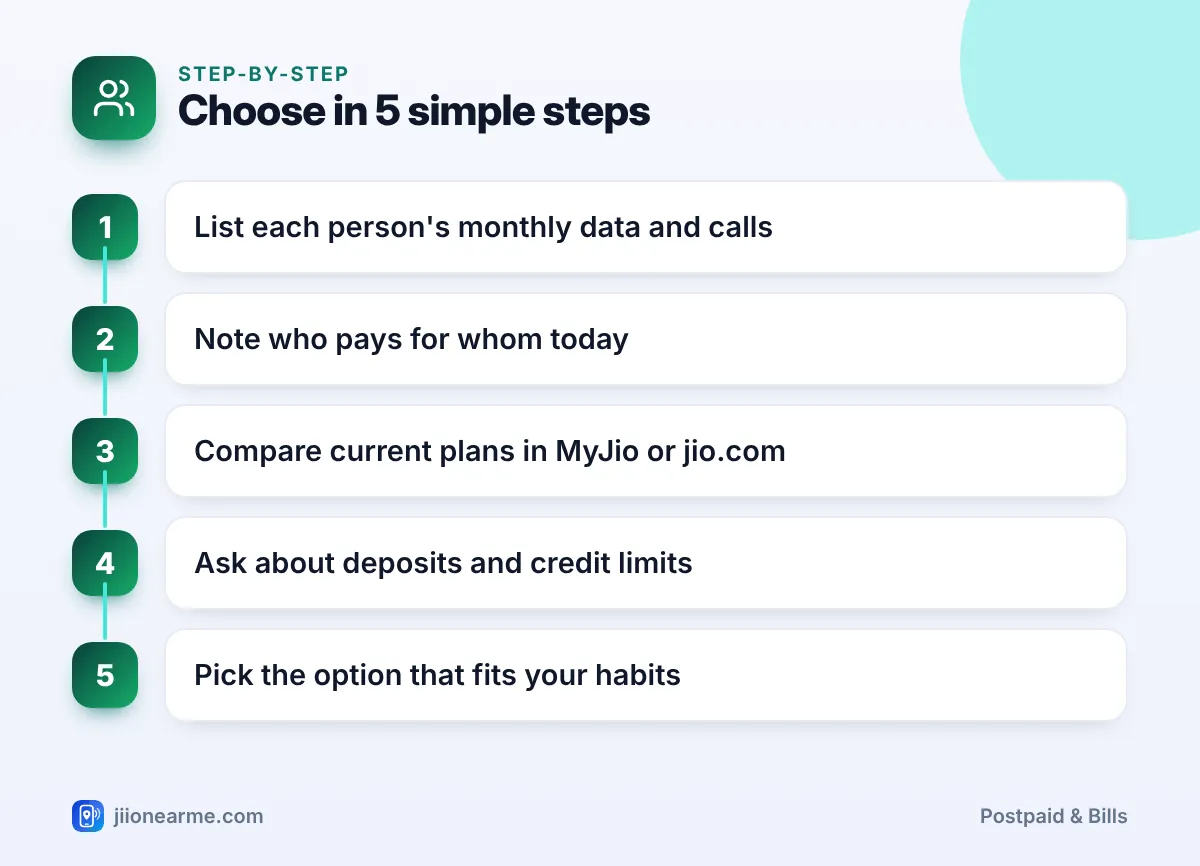
- List each person’s monthly data and call usage from their MyJio app.
- Note who pays for whom today.
- Compare current family and prepaid plans in MyJio or on jio.com.
- Ask about deposits and credit limits for postpaid.
- Choose the option that fits your habits, not just the one that looks cheapest on paper.
A mixed approach also works
You do not have to put everyone on the same type of connection. Many households keep parents and children on a JioPlus family plan, while a working sibling stays on their own prepaid number. This gives one person easy control over the bill for those who need help, and full independence for those who want it.
If you are unsure, start small. Move the members who forget to recharge most often to the family plan, and keep the rest on prepaid for a few months. You can then decide based on how the first few bills look.
Frequently Asked Questions
Is JioPlus always cheaper than separate prepaid numbers?
Not always. It depends on the plans available at the time, the number of members and how much each person uses. Compare current plans before you decide.
Can we try JioPlus and go back to prepaid later?
Usually yes. Members can typically move back to prepaid while keeping their numbers, after clearing any dues. Ask Jio about the current process.
Do family members keep their numbers on JioPlus?
Yes. Existing Jio numbers can usually be converted, and numbers from other operators can be ported in.
Is prepaid safer for avoiding bill shock?
Prepaid has no surprise bills because you pay in advance. On postpaid, regular bill checks and clear usage rules keep surprises small.
Can I pay for my family's prepaid numbers from my own phone?
Yes. You can recharge any Jio prepaid number from the MyJio app or on jio.com by entering that number. Each recharge still has its own validity to track.
Conclusion
Both options work well for the right family. Choose JioPlus for one bill and no recharge expiry, or separate prepaid numbers for independence and fixed spending.
Start with your family’s real usage and payment habits, then compare the current plans in MyJio or on jio.com. For specific questions about your numbers, call 199 from a Jio number.
JIo Near me is an independent guide and is not affiliated with Reliance Jio. App menus, plans and policies can change – always confirm current details in the official MyJio app or on jio.com. We will never ask for your OTP, PIN or passwords.