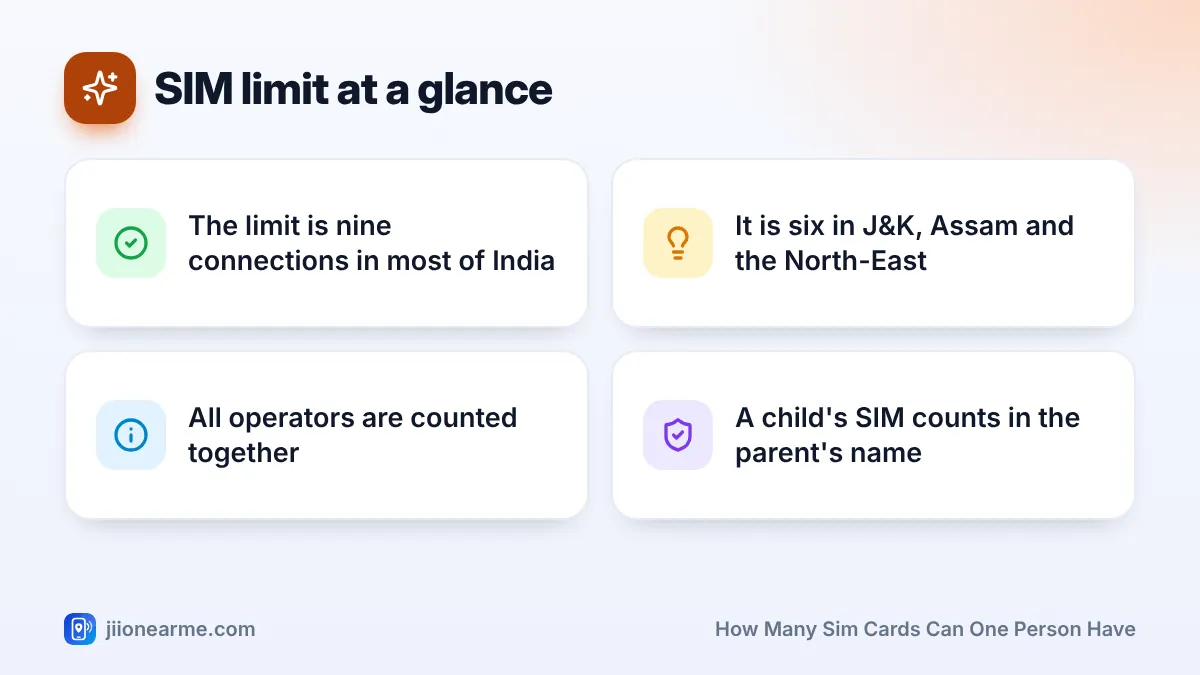
One person can hold up to nine mobile connections across all operators in most of India. In Jammu and Kashmir, Assam and the North-East, the limit is six. These numbers include every SIM registered against your identity, whether it is with Jio or any other operator.
This explainer covers how the limit works, why it exists, how connections are counted and what happens if you go over it. You will also learn how to check every number registered in your name in a few minutes.
- The limit is nine mobile connections per person, or six in Jammu and Kashmir, Assam and the North-East.
- It covers all operators together, not nine per operator.
- Holding more than the limit can lead to re-verification, disconnection and penalties under the law.
- Use the Sanchar Saathi portal to see and report every number linked to your ID.
How Many SIM Cards Can One Person Have in India?
The Department of Telecommunications (DoT) sets the limit on mobile connections per person. As per the current rules:
- Most of India: up to nine mobile connections per person
- Jammu and Kashmir, Assam and the North-East service areas: up to six mobile connections per person
The lower limit in some regions exists for security reasons. These rules can be revised, so check official DoT or Sanchar Saathi updates if you need to be certain.
This limit applies to individuals. Connections taken by a company or organisation in its own name follow separate business KYC rules.
How the Limit Is Counted Across Operators
The most common misunderstanding is that the limit applies per operator. It doesn’t. All your connections are added together.
| Your connections | Count towards the limit? |
|---|---|
| Jio prepaid and postpaid SIMs | Yes |
| SIMs from other operators | Yes |
| A SIM taken for your child or parent in your name | Yes |
| An eSIM on your phone | Yes, it is a connection like any other |
| A connection taken by your employer in the company’s name | Generally no, it is in the company’s name |
What matters is whose identity was used for KYC. If your Aadhaar or ID was used, the connection is in your name and counts towards your limit.
Parents often take SIMs for children, elderly relatives or house help in their own name. Each one counts against the parent’s limit and is the parent’s legal responsibility.
Why the Government Limits SIM Cards
SIM cards registered in bulk against one identity have often been misused. Fraudsters use extra SIMs to run scam calls, open fake accounts and hide their identity.
By limiting connections per person and linking every SIM to verified KYC, the system makes it harder to:
- Issue SIMs using someone else’s identity without their knowledge
- Run large-scale call and SMS fraud from untraceable numbers
- Use numbers for financial fraud that can’t be traced to a real person
For ordinary users, the rule mainly means one thing: know every number registered in your name.
What Happens If You Go Over the Limit
If you hold more connections than allowed, operators and the DoT can take action. In the past, people above the limit were asked to re-verify their connections and choose which ones to keep, with the rest being disconnected.
Under the Telecommunications Act, 2023, holding SIMs beyond the notified limit is a violation. It can attract financial penalties, which are higher for repeat violations. Getting a SIM using someone else’s identity, or through fraud, is treated much more seriously.
Never let a friend, colleague or stranger take a SIM using your ID, even “just for a while”. If that number is used for fraud, the trail leads to you.
How to Check SIM Cards Registered in Your Name
The government’s Sanchar Saathi portal lets you see every mobile connection linked to your identity across all operators.
- Visit sancharsaathi.gov.in in your browser.
- Look for the option to know mobile connections in your name. Labels can change over time.
- Enter your mobile number and the captcha, then type the OTP sent to that number.
- Review the list of numbers registered against your identity.
- Mark any number as Not my number if you never took it, or Not required if you no longer need it.

Reported numbers are checked and, where needed, disconnected by the operator. You will usually get a reference number for your request, so keep it for follow-up.
Check the portal once or twice a year, and after any time you have shared a copy of your ID. It takes only a few minutes and can catch misuse early.
How to Reduce the Connections in Your Name
If you are close to the limit, or have numbers you don’t use, clean things up:
- Surrender unused SIMs. Visit a store of the operator concerned with your ID and ask for the connection to be closed.
- Shift family members to their own KYC. Adults in your family can take their own connections.
- Port, don’t duplicate. If you are switching to Jio, port your existing number instead of buying a new one. SMS “PORT” followed by your 10-digit number to 1900 to get a Unique Porting Code.
- Report unknown numbers on Sanchar Saathi rather than ignoring them.
For your Jio connections, the MyJio app and Jio customer care can help. Call 199 from a Jio number for queries, or Jio’s toll-free number 1800-889-9999.
Frequently Asked Questions
Is the SIM limit nine per operator?
No. The limit of nine (or six in some regions) is the total across all operators together, not per operator.
Does a Jio eSIM count as a separate connection?
An eSIM is a mobile connection like a physical SIM, so it counts. Converting your existing physical SIM to an eSIM on the same number does not add a new connection.
What if someone took a SIM using my Aadhaar without my knowledge?
Check the Sanchar Saathi portal and mark the number as Not my number. If you suspect fraud, also call the cybercrime helpline 1930 or report on cybercrime.gov.in.
Do SIMs taken for my children count in my name?
Yes. Children under 18 can’t own a SIM, so it is registered in the parent’s name and counts towards the parent’s limit.
Will my extra SIMs be disconnected without warning?
Operators generally ask for re-verification before taking action. Still, it is safer to surrender unused connections yourself than to wait.
Wrapping Up
So, how many SIM cards can one person have? Nine across all operators in most of India, and six in Jammu and Kashmir, Assam and the North-East. Every connection taken with your identity counts, including those used by family members.
Check the Sanchar Saathi portal now and then, surrender numbers you don’t use, and never let anyone take a SIM with your ID. That keeps you within the rules and protects you from misuse.
JIo Near me is an independent guide and is not affiliated with Reliance Jio. App menus, plans and policies can change – always confirm current details in the official MyJio app or on jio.com. We will never ask for your OTP, PIN or passwords.