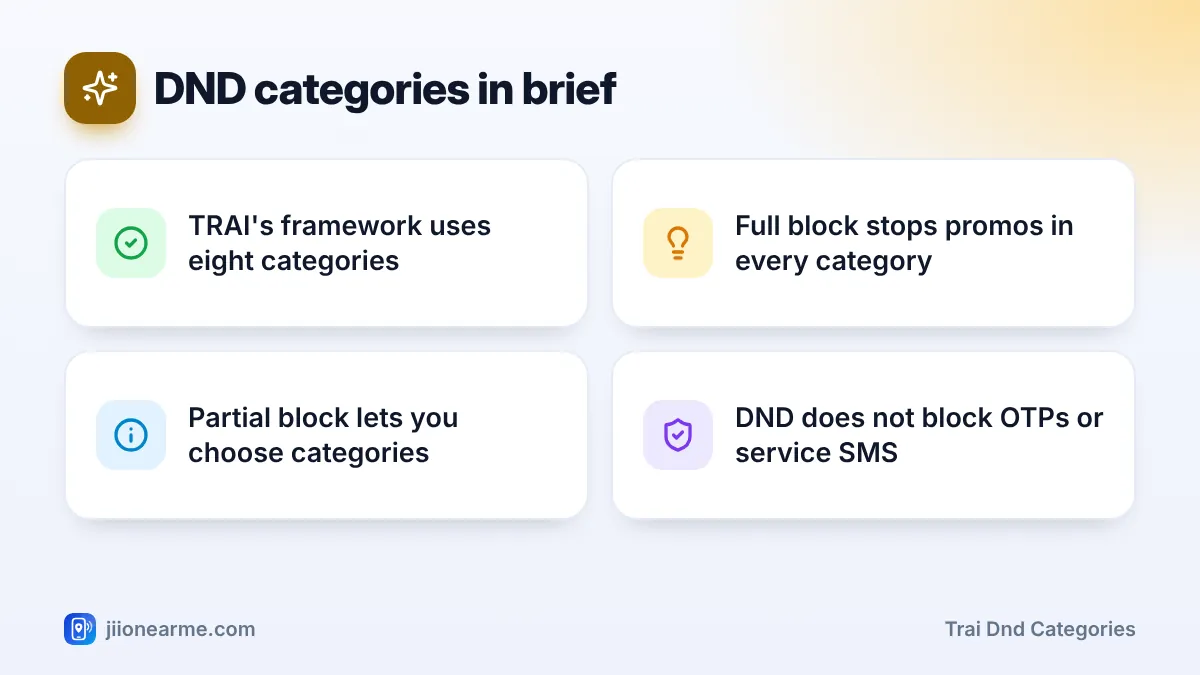
TRAI’s Do Not Disturb (DND) system sorts promotional calls and SMS into eight product categories, from banking and real estate to food and travel. Full block shuts out promotional messages in all of them. Partial block lets you decide category by category. Whichever you pick, OTPs, bank alerts and service messages keep arriving.
Below, you will find how the preference system works, what each category covers and how the two blocking options compare. The last part gives a simple way to choose the setting that suits you.
- Under TRAI’s rules, registered senders must tag each promotional message with a category.
- Full block stops promotional calls and SMS from registered senders in every category.
- Partial block lets you allow some categories, such as education during admission season.
- No category setting blocks OTPs, transaction alerts, service or government messages.
- You can change your preference whenever your needs change.
How TRAI’s DND Preference System Works
TRAI’s rules on commercial communication require businesses and telemarketers to register with telecom operators. Each promotional call or SMS they send must carry a category, such as real estate or health.
Your DND preference is recorded with your operator. Before a promotional message is delivered, the system checks your preference. If you have blocked that category, the message should not reach you.
You can set or change your preference in three ways:
- In your operator’s app, such as MyJio, under the DND or Do Not Disturb option.
- By calling or sending an SMS to 1909.
- Through the TRAI DND app on Android or iPhone.
The rules also allow preferences by mode, such as calls or SMS, and by time of day or day of the week. Which of these finer options you see depends on the app or menu you use.
If you gave a business explicit consent to contact you, for example by ticking a box while signing up, it may still send you messages even with DND on. You can withdraw that consent with the business, using the opt-out method it offers.
The Eight TRAI DND Categories
These are the categories in TRAI’s framework. Apps and voice menus may name or order them slightly differently.
| No. | Category | Typical promotional messages |
|---|---|---|
| 1 | Banking, insurance, financial products, credit cards | Loan offers, card upgrades, insurance and investment pitches |
| 2 | Real estate | New projects, flats, plots and rentals |
| 3 | Education | Coaching, courses, colleges and admissions |
| 4 | Health | Clinics, labs, health check-ups and wellness products |
| 5 | Consumer goods and automobiles | Appliance, clothing, car and two-wheeler sales |
| 6 | Communication, broadcasting, entertainment, IT | TV, broadband, apps, gadgets and events |
| 7 | Tourism and leisure | Holiday packages, hotels and travel deals |
| 8 | Food and beverages | Restaurant offers and food delivery deals |
Categories to think about first
Loan, credit card and property pitches are common reasons people turn on DND, so look closely at categories 1 and 2. If you are not shopping for a loan or a home, blocking them is usually sensible.
Category 1 covers only promotional offers. Your bank’s OTPs and transaction alerts are not promotional, so they still arrive.
Full Block vs Partial Block: Key Differences
Here is how the two options compare in daily use:
| What happens | Full block | Partial block |
|---|---|---|
| Promotional calls and SMS from registered senders | None, in every category | Only in the categories you allow |
| OTPs and transaction alerts | Delivered | Delivered |
| Service messages about your accounts and orders | Delivered | Delivered |
| Messages you gave explicit consent for | May still arrive | May still arrive |
| Effort needed | Choose once | Review now and then |
When full block makes sense
Full block is the simplest choice if you do not want any marketing at all. It suits busy people, students and older family members who should not have to judge each sales call.
When partial block makes sense
Partial block suits people who find some offers useful. Someone planning to buy a car may keep consumer goods and automobiles open. A parent comparing schools may allow education for a few weeks.
When you choose partial block, read the screen carefully. Depending on the app or menu, it may ask which categories you want to receive or which you want to block. Tick the boxes based on that wording.
What DND Categories Do Not Cover
DND controls promotional messages from registered senders. It does not cover:
- Transactional and service messages, such as OTPs, bank alerts, bills and delivery updates.
- Government messages and public alerts.
- Unregistered telemarketers who call from ordinary 10-digit numbers and ignore the rules.
- Fraud calls and SMS, which belong on Chakshu, not in a DND complaint.
- Messages inside apps, such as WhatsApp chats and emails.
Registered telemarketers make promotional calls from numbers in the 140 series. Many banks and financial firms have also started using numbers beginning with 1600 for service and transactional calls. A sales call from a regular mobile number is a sign of an unregistered sender, which you can report through the TRAI DND app or 1909.
How to Choose TRAI DND Categories That Suit You
A few minutes of thought now saves a lot of unwanted calls later.
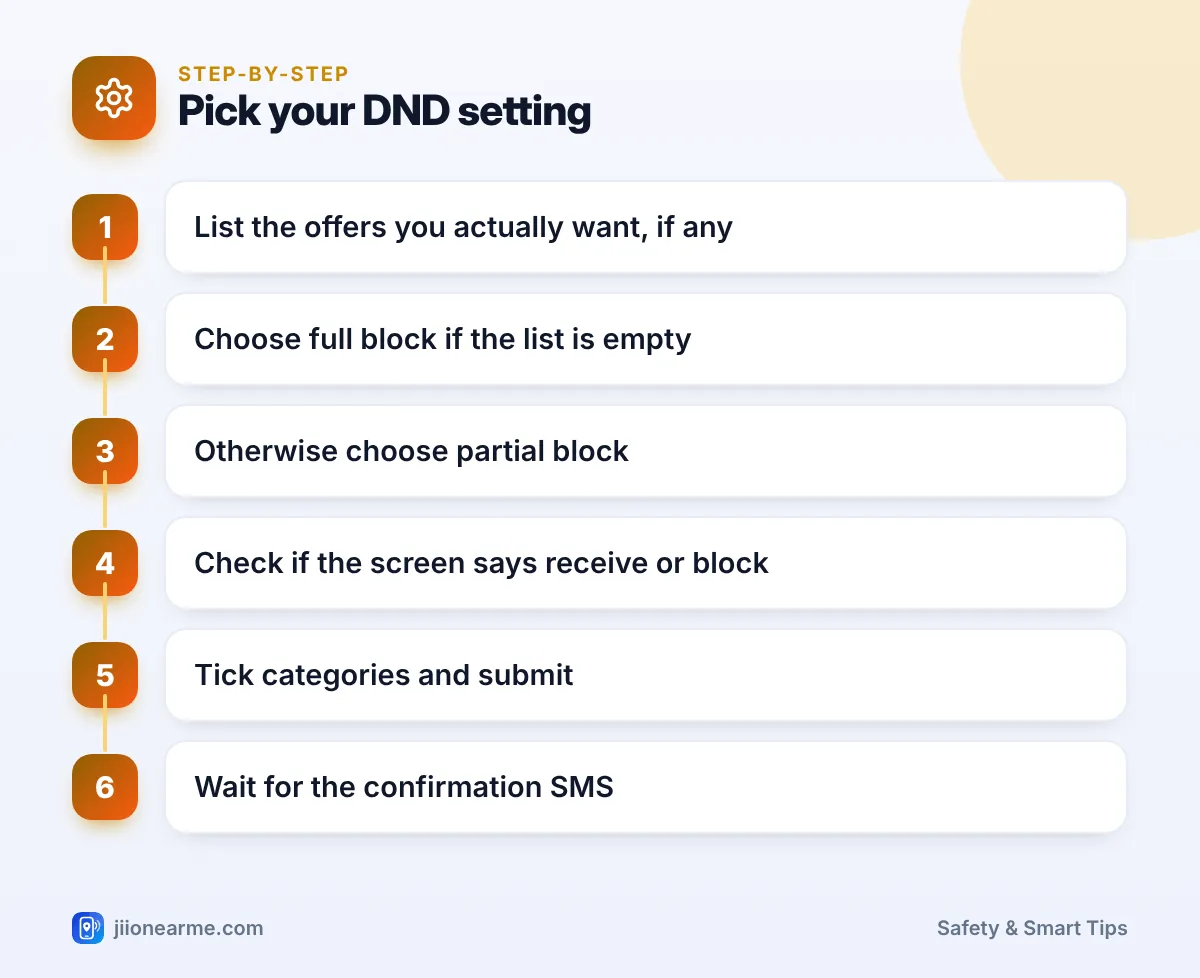
- Make a short list of promotional offers you genuinely want, if any.
- If the list is empty, choose full block.
- If it has items, choose partial block and match each item to a category from the table above.
- Open MyJio, the TRAI DND app or call 1909, and go to the DND preference option.
- Read whether the screen asks for categories to receive or to block, then tick accordingly.
- Submit and wait for the confirmation SMS. Changes usually apply within 24 hours.
Treat partial block as temporary. Allow a category only while you need it, such as real estate during a house hunt, then switch back to full block once you have decided.
Changing Your Preference Later
Your DND choice is not fixed. You can move between full and partial block, or change categories, as often as you need. Each change usually takes up to 24 hours to apply.
TRAI updates its rules from time to time, and category names or options may change. For official updates on customer preferences, see the TRAI website.
Frequently Asked Questions
How many DND categories are there under TRAI rules?
TRAI’s framework uses eight categories, from banking and financial products to food and beverages. Apps may group or name them a little differently.
Is full block the same as blocking all eight categories?
In practice, yes. Full block stops promotional calls and SMS in every category from registered senders. It is simply easier to choose in one step.
Can I block calls but still get promotional SMS?
TRAI’s rules allow preferences by mode, such as calls or SMS. Whether you can choose this depends on the app or menu, and the TRAI DND app may offer more detailed options.
Will full block stop calls from my bank?
It stops your bank’s promotional calls, such as loan or card offers. Service calls and transaction alerts about your own account can still reach you.
Conclusion
TRAI DND categories let you decide exactly how much marketing reaches your phone. Full block suits most people. Partial block works best for short periods when you want certain offers. Check your preference once in a while, and report any sender that ignores it.
JIo Near me is an independent guide and is not affiliated with Reliance Jio. App menus, plans and policies can change – always confirm current details in the official MyJio app or on jio.com. We will never ask for your OTP, PIN or passwords.